Most advice on how to study for long hours is the same six lines: sleep well, eat well, exercise, sit somewhere quiet, take breaks, use the Pomodoro technique. None of it is wrong. All of it skips the question that actually matters, which is how many hours of hard study a human being can do in a day before the extra hours stop counting.
There is research on that, and the number is smaller than most aspirants want to hear. But it does not mean a twelve-hour day is impossible. It means a twelve-hour day only works if you stop treating all twelve hours as the same kind of work.
What follows are the proven methods that survive contact with the evidence, plus the practical tips for turning them into a study routine you can hold for months rather than a fortnight of marathon study sessions followed by a write-off.
The real ceiling on study hours
When Ericsson and colleagues reviewed the training literature for their 1993 paper on deliberate practice, they compared studies running practice from one to eight hours a day. Their conclusion: “essentially no benefit from durations exceeding 4 hr per day and reduced benefits from practice exceeding 2 hr.” For some skills, the effective duration looked closer to one hour.
Across elite performers in music, sport, and writing, the same ceiling kept appearing — daily deliberate practice that never consistently exceeds about five hours. What limits them is not motivation or time management. Ericsson is explicit that the binding constraint is an inability to sustain the required level of concentration.
It does not mean you should study four hours a day and stop. It means roughly four hours is the budget for the hardest category of work. Everything else you do in a study day is a different, cheaper activity — and there is a lot of it.
Can I study for 12 hours a day?
Yes, and for a serious competitive exam you may have to. A UPSC or JEE study timetable built on ten to twelve hours is normal and it is not inherently harmful. What breaks people is spending those twelve hours pretending each one is a fresh four, which is what turns a long day into mental fatigue and eventually into burnout.
A realistic twelve-hour day contains about four hours of hard work, six or seven hours of support work, and one to two hours of genuine break. Written down that way it is achievable. Written down as “twelve hours of study” it is a plan for three good days followed by a collapse.
Can I study 20 hours in a day?
No, and the arithmetic is the reason. Twenty hours of study leaves four hours for sleep, meals, and everything else.
In a controlled study by Van Dongen and colleagues (2003), 48 healthy adults spent 14 consecutive nights restricted to 8, 6, or 4 hours in bed. The eight-hour group showed no cognitive deficits at all. The six-hour group ended up performing like people who had gone a full night without sleep. The four-hour group reached the level of two nights without sleep.
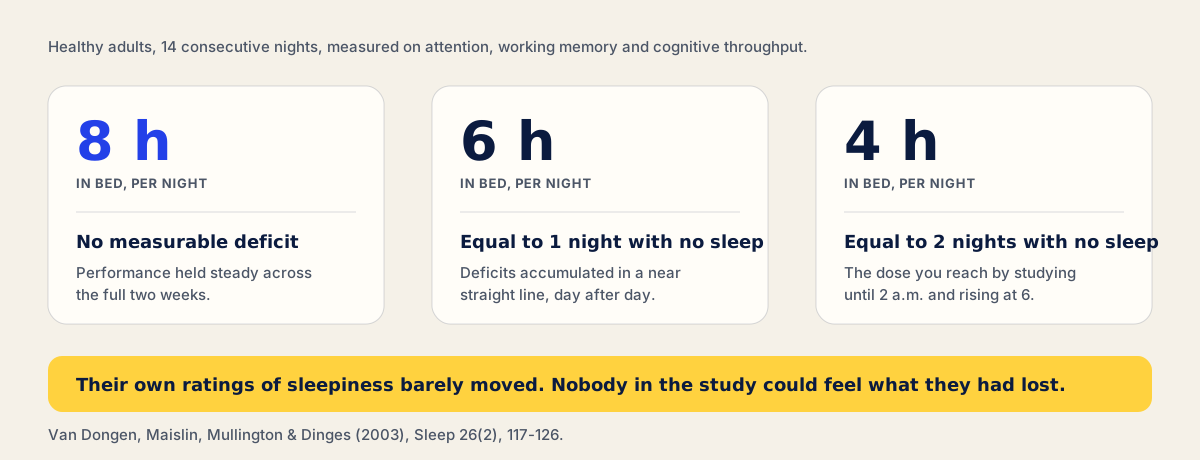
The detail that should worry anyone running a 20-hour schedule is the last one. Subjective sleepiness ratings rose a little at the start and then flattened out. The participants’ performance kept falling while their sense of how impaired they were did not. You do not get a warning light. You simply become worse at studying and continue to feel roughly normal.
Prioritise by difficulty: how to study for long hours without burnout
Here is the change that makes long study hours work, and it is the one missing from every listicle: sort your day by cognitive load before you sort it by subject.
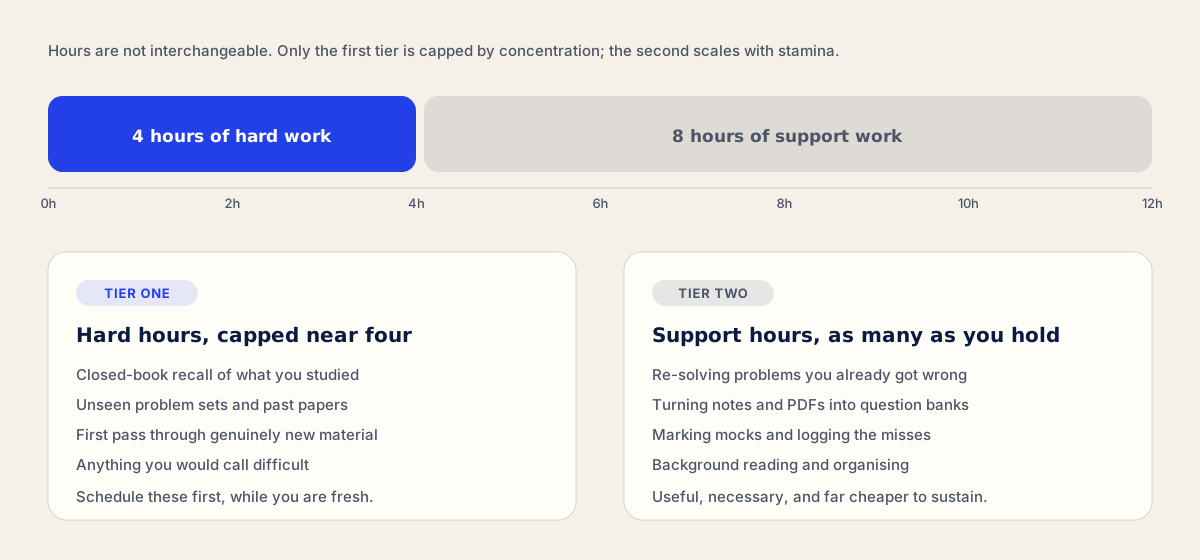
Tier one is anything that requires you to produce something you do not yet reliably know: recalling a topic with the book closed, attempting unseen problem sets, working through genuinely new material. This is the tier Ericsson’s four-hour ceiling applies to. Protect it, and schedule it early.
Tier two is everything else that still moves you forward — re-solving problems you already got wrong, marking mocks and logging misses, turning a chapter into a list of questions, background reading, organising. Most students do this work anyway. They just do it in a fog at 11 p.m. after burning the fresh hours on something easy.
The gain here is not willpower, it is learning efficiency. You are spending scarce concentration on the only work that needs it, which is how people study for longer without the total day becoming punishing.
A daily study schedule for long study hours
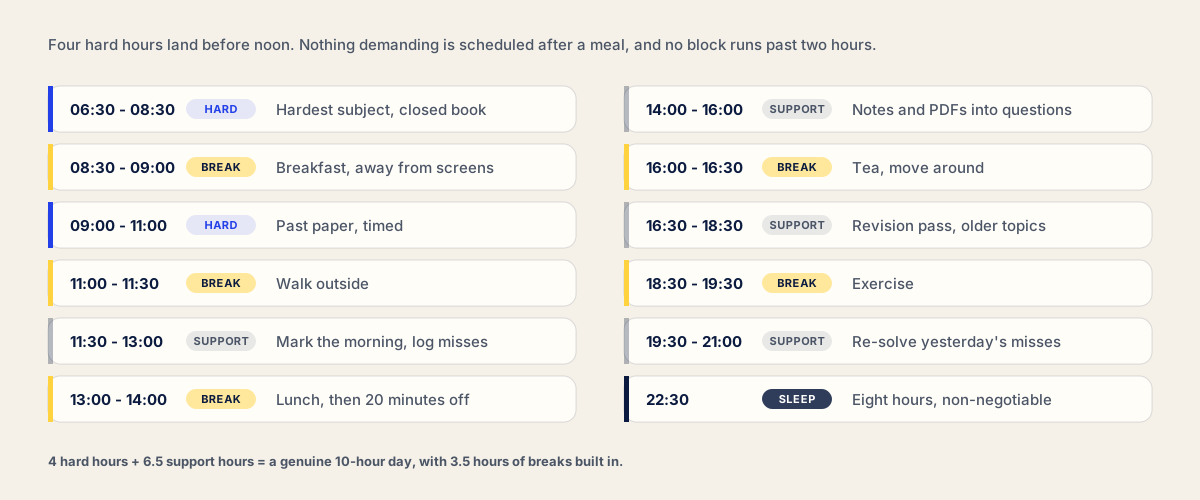
Three rules make this hold up rather than any specific clock time. No block runs longer than two hours. Nothing demanding is scheduled immediately after a heavy meal. And the hard blocks go in the first half of the day, because that is when you can spend concentration you will not get back.
Adjust the times to your own rhythm. Some people genuinely do their best thinking at night, and the structure works just as well shifted by four hours. What does not work is leaving the placement to chance and studying whatever feels approachable at the moment you sit down.
Switching between subjects across blocks helps more than it looks like it should, and not only because variety is pleasant — alternating related topics rather than finishing one before starting the next is one of the better-evidenced ways to retain information.
Why you get tired during a long study session
The standard explanation is that attention is a fuel tank and concentration drains it. That framing is popular, intuitive, and probably wrong.
Ariga and Lleras (2011) proposed instead that performance falls because the brain stops actively holding the goal in mind — goal habituation, not depletion. They tested it with a 40-minute vigilance task. One group just did the task and declined steeply over time, as expected. A second group was asked to briefly switch to an unrelated memory check twice during the session. That group showed no decline at all.
As Lleras put it, attention is not the problem: “You start performing poorly on a task because you’ve stopped paying attention to it. But you are always paying attention to something.” Two short interruptions were enough to reactivate the goal and hold performance flat for the full session.
You will see it claimed that humans run on a 90-minute alertness cycle and should study in 90-minute blocks. The 90-minute rhythm is well established in sleep. For waking cognition the evidence is inconsistent, and controlled tests have failed to find a 90-minute cycle in cognitive performance. Treat block length as a preference to be tuned, not a biological law.
Take breaks early: why taking small breaks beats pushing through
Nobody studies six hours straight, and the students who claim to are usually counting the time their book was open. Studying for hours without breaks does not make you diligent; it makes the last half of every block worth less than the first. The practical implication of the research above is that regular short breaks work best when they arrive on a schedule, not when exhaustion finally forces one.
A break that restores you has to actually switch the goal. Scrolling is a poor break because it demands the same kind of attention you were just spending, which is why a “five-minute” phone break reliably becomes twenty. Standing up, walking outside, staring at something far away, 5-15 minutes of physical activity, or a couple of minutes of meditation all work better precisely because they are unlike the task and genuinely refresh your mind.
The Pomodoro technique — 25 minutes on, 5 off — is a reasonable default and a good way to start when you cannot get going. It has no real evidence base as a learning method, so treat the 25 minutes as arbitrary. Longer blocks of 50 to 90 minutes suit deep work like problem sets; shorter ones suit revision. What matters is that you take a break on purpose, and that the break is genuinely different from the work.
Protect sleep, or the exam collects the bill
Sleep is not recovery time subtracted from study time. It is when the brain does the work of processing and storing what you covered, which means cutting it directly reduces your ability to retain information from the hours you did put in.
Work reported by Walker and Stickgold found that people kept awake for 36 hours showed a 40% reduction in their ability to form new memories compared with people who had slept normally — measured after two recovery nights, so this is not simply next-day grogginess. Sleep before learning turns out to matter as much as sleep after it.
7-8 hours is the target, and it should be the last thing you cut, not the first. Chronic short sleep also drives up stress and anxiety, which is how a study schedule starts costing you mental health as well as marks. If your timetable does not fit around the sleep, the timetable is too long.
A daytime nap can buy back part of a bad night, but only if you pick the length deliberately — ten minutes and thirty minutes do measurably different things, and the popular advice has the thirty minute nap backwards. The evidence is in best nap length for studying.
What is the 7-8-9 rule for studying?
The 7-8-9 rule usually means splitting the day into 7 hours of study, 8 hours of sleep, and 9 hours for meals, travel, exercise, family, and rest. There is also an unrelated wellness version — dinner at 7 p.m., screens off at 8, asleep by 9 — so check which one is meant before following it. You may also meet the 9-8-7 rule, which shuffles the same numbers into 9 hours of study and 7 of everything else.
None of these are research findings; they are planning heuristics, and the ratios are arbitrary. The part worth keeping is the eight hours of sleep, which is the only number in the rule with evidence behind it. Treat the study figure as a ceiling to stay under rather than a quota to hit.
How can I focus 100% on study?
You cannot, and chasing it wastes more time than the distractions do. What you can do is make the alternative to studying cost something.
Vague intent is what phones exploit. “Study chemistry” has no finish line, so checking a notification costs nothing. “Answer these fifteen questions from memory, then mark them” is a clear goal with an end, and the interruption becomes visible. Set the task before you sit down, not after — that single habit does more for your ability to focus than any app.
Then remove the friction, because fewer distractions beat more willpower. Turn notifications off rather than trusting yourself, since digital distractions win every contest with intention. Keep a study area used only for studying, so sitting there is itself a cue to concentrate. Keep the room well-lit and cool enough that you are not fighting drowsiness, and keep water on the desk — two to three litres of water across a long day matters more than it sounds, because mild dehydration shows up as feeling sleepy rather than thirsty. If the space is noisy, headphones help; if you listen to music, instrumental is safer than anything with words.
None of this buys you hours without distractions in the absolute sense. It buys you a setup where you notice when you get distracted, which is the part you can act on.
~4 h
daily ceiling on genuinely hard study found across training studies
6 h
of sleep for 14 nights equalled one full night of sleep deprivation
0
decline in the group given two brief breaks during a 40-minute task
Active learning beats extra study time
If you have to choose between adding two hours and improving what happens in the hours you already have, improve the hours. Active learning techniques — active recall, self-testing, explaining a topic aloud, working past papers — produce far more per hour than rereading does, and rereading is what most long study sessions quietly turn into.
This matters doubly for long days, because passive study is what makes the afternoon feel interminable. Reading a chapter for the third time is boring precisely because nothing is being asked of you; you lose concentration and never notice. Active study is harder but it keeps you awake and alert, and it gives you a score, which tells you whether the hour was worth anything. For exams like UPSC, JEE, or NEET, where the paper is a test of retrieval under time pressure, that is also the only practice that resembles the real thing.
We have gone through the evidence for this in detail in 7 secret methods for studying — including the experiment where one group read a passage 14 times and another read it 3 times with self-testing, and the self-testing group remembered half again as much a week later. The simplest way to run it on a full day of material is the blurting method: close everything and write out what you remember.
It also settles a question that eats a lot of planning time. Long-hours advice often tells you to study in the format that suits your learning style. It does not matter, and the research on learning methods is unusually clear about why. What you do in the hour decides the outcome; the format it arrives in does not.
Common mistakes when it comes to studying for long hours
Counting hours instead of output. Time at the desk is easy to measure and almost meaningless. Set study goals in questions answered, not hours logged — it is the fastest way to increase productivity without adding a single minute.
Spending the fresh hours on easy work. Organising notes at 7 a.m. and attempting problem sets at 10 p.m. is the most common self-inflicted wound in a long study day.
Treating breaks as a reward for exhaustion. By the time you feel you have earned a break, you have already been studying badly for a while.
Cutting sleep first. It is the only variable that reduces the value of every other hour you spend.
Studying to the point of no motivation and calling it discipline. A lack of motivation after three brutal weeks is not a character failure, it is the predictable result of a schedule that had no slack in it. Steady ten-hour days beat alternating fifteen-hour days and write-offs. Preparation is a marathon; consistency compounds and heroics do not.
Where AI summarizing fits into a long study day
A large part of any competitive exam is volume — hundreds of pages of PDFs, standard textbooks, coaching notes, previous years’ papers. Most of the hours students lose are not lost to distraction. They are lost to reading things that did not need reading closely.
That is a sorting problem, and it belongs in tier two.
- 1
Summarize first to decide what deserves the hard hours
Run a chapter, a paper, or a set of coaching notes through a summarizer and read the key points. You are not learning yet — you are working out which forty pages matter and which forty do not.
- 2
Convert the key points into questions
Rewrite each one as something you must answer. Building this question bank is support work, so put it in an afternoon block, not a morning one.
- 3
Answer them in a hard hour, with everything closed
This is the part that actually counts, and it is why the summary exists. A summary you have read is not a topic you know.
In practice that means putting the day’s PDFs — coaching notes, a standard textbook chapter, a previous year’s paper — through the PDF summarizer before you decide where the hard hours go. Files up to 50 MB are supported, which covers most coaching material, and there is no signup. Recorded classes are the other big time sink on a long day: paste the transcript into the text summarizer and you can tell in a minute whether the lecture is worth rewatching at all.
If you are assembling a fuller kit for the year, we compared the realistic options in best AI study tools.
One caution, repeated from our guide to summarizing a PDF: summaries fail quietly. A date slips or a qualifier disappears while the prose stays confident. Anything you plan to write in an exam should be checked against the source once.
Frequently asked questions
How many hours should a student study in a day?
For school exams, two to four focused hours on top of class is usually plenty. For a full-time competitive exam, eight to twelve hours is normal, but only about four of those should be genuinely hard work. The rest is revision, marking, and building practice material, which is real work that costs far less concentration.
Is it better to study continuously or take breaks?
Take breaks, and take them before you feel you need one. In a 40-minute vigilance experiment, the group given two brief unrelated interruptions showed no performance decline at all, while the group that worked straight through declined steeply. Breaks appear to reset the goal your brain is holding, rather than refill a tank.
How can I study for long hours without getting tired or sleepy?
Put the hardest work in your freshest hours, keep blocks under two hours, break between every block, and do not schedule demanding material straight after a heavy meal. Drink water, since mild dehydration shows up as fatigue. If you are sleepy every afternoon regardless, the problem is usually the previous night rather than the timetable.
Can I study 20 hours in a day?
Not usefully, and not twice. Twenty hours of study leaves four for sleep, and four hours in bed for two weeks produced cognitive deficits equal to two full nights without sleep. Worse, participants in that study barely noticed the decline, so you cannot rely on feeling bad as a warning.
Does the Pomodoro technique work for long study hours?
It is a useful way to start a session when you are procrastinating, and the structure prevents you from working until you crash. The specific 25 minutes has no evidence behind it, so tune it: longer blocks of 50 to 90 minutes tend to suit problem solving, shorter ones suit revision.
What should I do when I feel bored or unmotivated mid-session?
Boredom during study is usually a symptom of passive work. Switch from reading to answering — close the book and write what you remember, or attempt a past question. It is harder, which is precisely why it is less boring. If that does not help, take a proper break and do something physical.
The short version
You cannot buy much more hard study by sitting longer. The ceiling on demanding work is roughly four hours, and beyond it the extra time produces little. What you can buy is a much longer total day, by being honest that most of a study day is support work and scheduling it as such.
So put the hard hours first, keep blocks short enough that you finish them still thinking, break on a timer rather than on exhaustion, and defend the eight hours of sleep that decide whether any of it gets remembered. A steady ten-hour day you can repeat for six months beats a fifteen-hour day you can repeat for four.