Almost every guide to napping for students gives you the same three numbers. Ten to twenty minutes is the sweet spot. Thirty to sixty minutes is the danger zone. Ninety minutes is a full sleep cycle. The advice is repeated so consistently that it reads like settled science.
It is not. In 2023 a team at the National University of Singapore ran the experiment that this advice had never actually been tested against: they put the same people through 10, 30 and 60 minute naps in random order, measured every nap with electrodes, and checked what each duration did to memory rather than just to alertness.
The 30 minute nap — the one sitting squarely in the “danger zone” — was the only duration that improved memory.
That is not a small detail for a student. It means the standard advice is optimised for the wrong outcome. It comes from research on exhausted pilots who needed to stay awake, and staying awake is not the thing you are trying to do when you sit down with three chapters of material.
So how long you should nap turns out to depend entirely on what you want back: raw energy levels, new material going in, or old material staying put. Below is the science behind power naps at each length: what a given nap duration actually delivers, where the famous numbers came from, and how to place a nap in a real study session without disrupting your nighttime sleep.
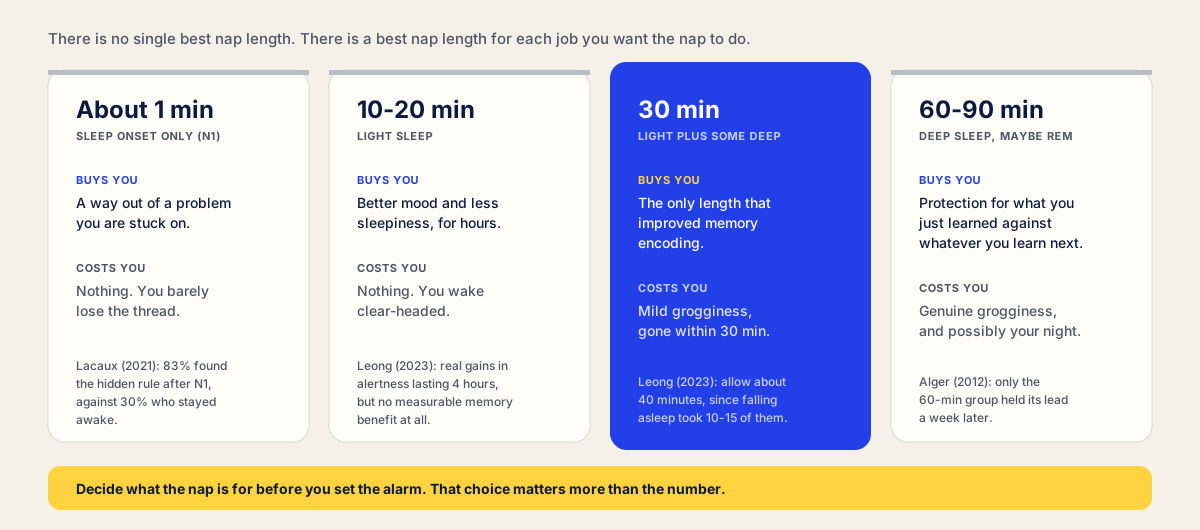
The best nap length for studying depends on the job, not on a single number
The question “what is the best nap length for studying?” hides a second question that nobody asks first: what do you want the nap to do?
Studying is not one activity. Sitting through a lecture you are too tired to follow is an alertness problem. Trying to get twelve pages of pharmacology into your head is an encoding problem. Protecting that pharmacology from the statistics you have to learn straight afterwards is a consolidation problem. Being stuck on a proof for forty minutes is an insight problem.
Those four problems have four different answers, and the research now separates them cleanly enough that you can choose deliberately. Asking for the optimal nap length for studying without saying which of them you are facing is like asking how much money you should spend without saying what you are buying.
What actually happens in each sleep stage during a daytime nap
To see why nap duration changes the outcome, you need the mechanism, and it is simpler than most explanations make it.
When you take a nap you do not drop into one uniform state. You move through the same stages of sleep you pass through at night, just fewer of them. Sleep is divided into non-rapid eye movement sleep and rapid eye movement sleep, and non-REM splits again into three stages, described in the StatPearls chapter on sleep physiology hosted on PubMed Central (PMC):
- 1
N1 — sleep onset
The border between awake and asleep, usually lasting only a few minutes. Thoughts drift and loosen. Woken from here, many people insist they were never asleep. It turns out this stage does something specific and useful.
- 2
N2 — light sleep
The bulk of a short nap. The brain produces sleep spindles, short bursts of activity increasingly linked to shuttling new information out of temporary storage. Easy to wake from, which is why short naps leave no grogginess.
- 3
N3 — slow-wave sleep
Deep sleep, typically beginning around 20 to 30 minutes in. This is where memory consolidation does its heaviest work, and also where sleep inertia comes from. Waking out of N3 is the horrible one.
- 4
REM — rapid eye movement sleep
Dreaming sleep, associated with procedural memory, emotional processing and the recombination of ideas. REM sleep during a daytime nap is rare: you usually only reach it after roughly an hour, and even then not reliably.
The standard advice follows directly from stage three of that list. Stay under 20 minutes, never reach the deeper stages of sleep, wake up clean. It is internally consistent. It is also built on the assumption that feeling groggy is the main cost worth avoiding — which is true if you are landing an aircraft, and much less obviously true if you are revising for an exam in eleven days.
A nap long enough to complete a full sleep cycle sits at the other extreme, and we will come back to why that particular number is shakier than it sounds.
The 2023 sleep study that compared a 10, 30 and 60 minute nap head to head
Most napping research compares “a nap” with “no nap.” That tells you nothing about duration. The study that does is Leong and colleagues (2023) in Sleep, from the Centre for Sleep and Cognition at NUS Medicine.
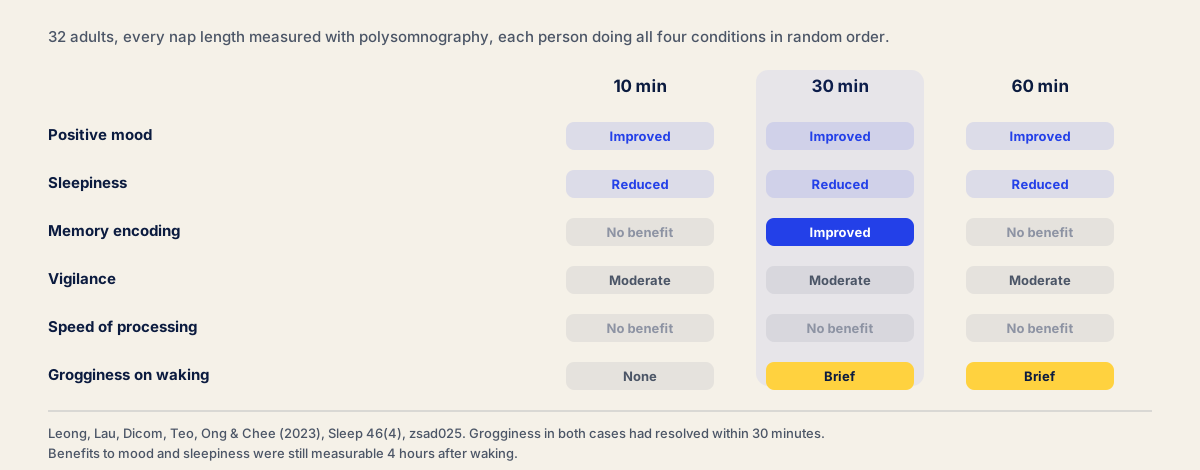
Thirty-two young adults each went through four conditions in random order: a 10 minute nap, a 30 minute nap, a 60 minute nap, and staying awake. Every nap was recorded with polysomnography, so the researchers knew which sleep stages each person actually reached rather than assuming. Outcomes were measured repeatedly for four hours afterwards.
Three findings matter for students.
Every nap length worked for mood and somnolence. Positive mood rose and subjective sleepiness fell after all three durations, and the effect was still measurable four hours later. If your only goal is to stop feeling like a corpse, ten minutes genuinely does it, and you do not need more.
Only the 30 minute nap improved memory encoding. Not the 10, and — surprisingly — not the 60 either. This is the finding that contradicts essentially every study-advice article on the subject.
Nothing improved speed of processing. Naps did not make anyone think faster, and none of the durations did anything to improve reaction time. Vigilance gains were there but moderate. A nap is not a cognitive upgrade; it is a repair to a specific kind of deficit. A nap may restore what fatigue took away, but it will not lift you above your own baseline.
This is the nuance that gets flattened whenever someone writes that naps improve cognitive performance. They improve parts of it. Alertness and cognitive performance are not the same variable, and the parts that respond to a nap depend on how long the nap was.
The authors also found no significant association between sleep macrostructure and the memory benefit, which is an honest and slightly awkward result: they could not fully explain why 30 minutes was the winner from the sleep stages alone. That uncertainty is worth stating plainly, and it is the sort of thing that gets sanded off when a finding is retold third-hand.
This is a well-designed trial — within-subject, randomised, polysomnography-verified — but it is 32 young adults, and the memory test was picture encoding rather than a biochemistry chapter. Treat “30 minutes is better for memory than 10” as a well-supported working conclusion, not a law. The wider literature agrees on the general direction: a 2021 meta-analysis of short daytime naps found cognitive benefits that were real but modest and highly dependent on what was measured.
Why a short nap gives you an energy boost but no memory benefit
A 10 to 20 minute nap is close to a free lunch. You barely leave light sleep, you wake without inertia, and you get several hours of feeling substantially less awful. For a student who is simply too tired to keep reading, that is exactly the right tool, and it costs almost nothing. This is the nap that lives up to the popular promise: a quick snooze really can help with energy and focus, and the effect on concentration is large enough to notice. A 20-minute nap will reliably boost energy, cut fatigue and improve alertness, all without interfering with nighttime sleep if you take it early enough in the day.
What a short nap does not appear to do is help you take in new material. In the Singapore trial the 10 minute condition produced no memory advantage at all, despite producing the same improvements in alertness as the longer naps.
This distinction gets lost constantly. A great deal of study advice slides from “a 20 minute power nap improves alertness” to “a 20 minute power nap can significantly improve your focus and memory,” and the second claim does not follow from the first. Feeling sharper and encoding better are different things, and the same nap can deliver one without the other.
So a short nap is the right choice when the material is easy and the problem is that your eyes keep closing. Use that nap to boost focus through an afternoon of revision you have already done once. It is the wrong choice when you have a dense chapter ahead of you and forty spare minutes.
30 minutes: the length every study guide calls the danger zone
Here is the head-on disagreement.
Search for nap advice and you will be told that 30 to 60 minutes is the window to avoid, because you risk waking out of deep sleep and losing half an hour to grogginess. The top-ranking student guides say this in almost identical words. One calls it, flatly, “the danger zone.”
The Singapore trial measured that exact risk, and the cost turned out to be smaller than advertised. Yes, both the 30 and 60 minute naps produced sleep inertia. It resolved within 30 minutes. In exchange, the 30 minute nap was the only one that improved memory encoding.
That is a trade, not a danger. Half an hour of feeling fuzzy in exchange for taking in new material more effectively is a bargain for a student preparing for exams, and a terrible one for a pilot on final approach. The advice you have been reading was written for the pilot.
Participants in the trial took 10 to 15 minutes to fall asleep. If you set a 30 minute alarm from the moment you lie down, you get roughly 15 to 20 minutes of actual sleep — the alertness nap, not the memory nap. To get a real 30 minute nap, give yourself about 40 minutes of clock time. This single adjustment is probably the highest-value thing in this article.
What longer naps do that short ones cannot
If 30 minutes wins on encoding, why bother with 60 or 90?
Because encoding and durability are different problems, and the answer comes from a separate experiment: Alger, Lau and Fishbein (2012). They compared a 10 minute nap, a 60 minute nap and staying awake, then tested recall — but with a twist. After the nap, participants did an interference task designed to scramble what they had just learned, roughly simulating what happens when you study statistics immediately after pharmacology.
Ninety minutes later, both nap groups beat the wake group. But after the interference task, and again a week later, only the 60 minute group — the group that reached slow-wave sleep — still held its advantage.
So longer naps are not about learning the material better. They are about the material surviving contact with everything that comes after it. If you are cramming several subjects into one day, that is precisely your problem, and it is an argument for the long nap that none of the short-nap advice addresses.
The costs are real, though. The effects of sleep inertia after a one-hour nap are genuine, a 90-minute nap eats an hour and a half of study time, and napping too long in the late afternoon will make it harder to fall asleep at night. That last one matters more than it sounds: a nap that steals from your night is a net loss, because nothing a nap does compares to what a full night’s sleep does. What matters is your total sleep time across the twenty-four hours, and a nap only helps if it adds to that figure rather than moving hours of sleep around. We go into how sleep interacts with long hours of studying in more detail in our guide to studying for long hours without burning out.
Is 26 minutes the perfect nap? What the NASA research actually measured
The single most-repeated fact in this entire topic is that NASA determined the ideal nap length to be 26 minutes, producing a 34% improvement in performance and a 54% improvement in alertness. You will find it in the Sleep Foundation’s article on the NASA nap, medically reviewed by Dr Pranshu Adavadkar, and repeated onward from there into hundreds of study blogs and at least one bestselling book.
The primary source tells a different story. The study is Rosekind and colleagues, NASA Technical Memorandum 108839, with results summarised in the Journal of Sleep Research in 1995. Twenty-one pilots on long-haul transoceanic flights were split into a rest group and a no-rest group. The rest group was given a 40 minute planned rest opportunity in the cockpit seat.
They fell asleep in an average of 5.6 minutes and slept an average of 25.8 minutes.
That is where 26 comes from. It is not an optimum that NASA searched for and found. It is a description of how long tired pilots happened to sleep when handed a 40 minute window and told to try. Nobody compared 26 minutes to 20, or to 35. The number has been promoted from an observation into a prescription somewhere along the chain of retellings.
40 min
Rest opportunity the pilots were actually given
5.6 min
Average time they took to fall asleep
25.8 min
Average sleep obtained — the famous '26 minutes'
The 34% and 54% figures are real, but they are narrower than they sound. They come from a psychomotor vigilance task — mental chronometry, essentially measuring reaction time — and from EEG-measured microsleeps during the final, most demanding phase of flight. They describe alertness in sleep-deprived professionals doing a monotonous monitoring task at the end of a transoceanic night flight. They say nothing whatsoever about memory, and nothing about students.
None of this makes the NASA work bad. It was careful applied research and it changed aviation safety policy in space and on earth. It simply does not answer the question people cite it for.
Forget 26. The genuinely transferable finding is the 40 minute window. NASA planned for the gap between lying down and being asleep, which is the step almost every student skips. Plan the window, not the nap.
Is the 8 minute Navy SEAL nap real?
Partly. The origin is real; the framing is not.
The technique comes from Jocko Willink, a retired US Navy SEAL officer, describing his personal routine on a podcast in 2019: lie on the floor, put your feet above your heart, set an alarm for eight minutes, and you wake up feeling like you slept for hours. It spread through TikTok, then through the Guardian and most of the lifestyle press.
It is one man’s habit, not a SEAL protocol, and there is no study of it.
Two specific problems. First, the leg elevation does nothing for sleep. Sleep specialists quoted across the coverage are consistent that raising your legs affects venous return and swelling, not sleep quality. Second, and more importantly, eight minutes is roughly how long it takes a typical person to fall asleep. In the Singapore trial, sleep onset took 10 to 15 minutes. An eight minute alarm set from the moment you lie down is, for most people, eight minutes of lying on the floor.
Which is not nothing — lying still with your eyes closed is restful. But if you want the benefits of a short nap, the honest version is to set the alarm for 20 minutes and accept that the first half of it is the runway.
The one minute nap: why a quick snooze can unstick a problem
There is one nap length shorter than the Navy SEAL nap that does have hard evidence behind it, and almost nobody writing about studying mentions it.
Thomas Edison is said to have napped holding steel balls over metal pans, so that as he drifted off his hands would relax, the balls would clatter down and wake him with whatever his loosening mind had just produced. Salvador Dalí described the same trick with a key. The anecdotes are unverifiable. The technique was finally tested properly.
Lacaux and colleagues (2021), in Science Advances, gave 103 participants maths problems that contained a hidden shortcut allowing them to be solved almost instantly. Nobody was told the shortcut existed. Participants then had a 20 minute rest period holding an object, with EEG recording their sleep stages, before returning to the problems.
83%
of those who reached N1 discovered the hidden rule
31%
of those who stayed fully awake
14%
of those who slipped into deeper N2 sleep
Spending as little as 15 seconds in N1 nearly tripled the chance of insight compared with staying awake. Going deeper destroyed the effect entirely — the N2 group did worse than the people who never slept at all. The researchers also confirmed that the falling object is a genuinely reliable marker of sleep onset, which is the part of the Edison story that turns out to be true.
This is a real and quite narrow tool. It will not help you memorise anything. It helps when you are stuck on a problem that has a solution you cannot see, which is a specific and familiar kind of stuck in maths, physics and programming. And unlike every other nap on this list, the window is so short you need something in your hand to catch it.
What is the 30-60-90 nap rule, and does it hold up?
The 30-60-90 rule is a rule of thumb that assigns a purpose to each length: 30 minutes for alertness, 60 minutes for retaining facts, 90 minutes for a full sleep cycle including REM, which is associated with creativity and procedural memory.
Judged against the evidence above, it holds up unusually well — better, in fact, than the more popular “10 to 20 minutes only” advice, because at least it acknowledges that different durations do different jobs.
Two corrections. The first is that 30 minutes does more than alertness; it is the length with the best direct evidence for memory encoding. The second concerns the 90.
The claim that a sleep cycle is 90 minutes is a population average treated as a constant. Real cycles range from roughly 70 to 120 minutes, they vary between people and between cycles in the same person, and the first cycle of a sleep period is unusual: it is heavy on slow-wave sleep and light on REM, with REM periods lengthening across the night. A daytime nap is always a first cycle. So the reasoning “90 minutes gives me a full cycle including plenty of REM” does not reliably work — you may get very little REM, and you may still be woken mid-cycle at 90 minutes because your cycle is 110.
If you want the deep-sleep protection described earlier, aim for 60 to 90 minutes and accept that you are aiming at a moving target. If you are setting a 90 minute alarm specifically hoping to wake up refreshed at a cycle boundary, that is astrology with better branding.
How to fit a power nap into your study routine
- 1
Decide what the nap is for, before you lie down
Too tired to keep reading? 20 minutes. About to start a heavy new chapter? 40 minutes of window for a 30 minute nap. Learned something this morning that you need to protect from this afternoon's subject? 60 to 90. Stuck on one problem? One minute, holding something.
- 2
Nap before studying the hard material, not after it
The Singapore trial measured encoding of material learned after the nap. That is an argument for treating a 30 minute nap as preparation for a study session rather than a reward for finishing one.
- 3
Take the nap in the early afternoon
Roughly 1pm to 3pm lines up with the natural afternoon dip in most people's circadian rhythm, which means you fall asleep faster and take less out of your night. After about 4pm, the arithmetic starts turning against you.
- 4
Try caffeine immediately before a short nap
Caffeine takes around 20 to 30 minutes to take effect, so drinking a coffee and immediately napping means it arrives as you wake. The coffee nap has modest but real support, including a randomised pilot study in simulated night-shift workers.
- 5
Set the alarm and put the phone out of reach
Obvious, and still the failure point. The most common way a study nap goes wrong is not the wrong duration, it is no alarm and a forty-minute plan that turns into a two-hour oversleep.
The piece of this that students consistently get wrong is the second step. A nap gets framed as recovery — something you earn once you are already wrecked. The encoding data suggests the opposite framing is more useful: a 30 minute nap is a setup move, deployed in front of the material that matters most.
The other thing worth saying is that a nap is not a substitute for ordinary study breaks. Short breaks between blocks of work do a different job: they let attention recover without any sleep involved, and you need them whether or not you nap. Plenty of people get through exam season perfectly well without naps. A nap is an extra tool for the days when the amount of sleep you got last night was not enough to carry the day you have planned.
A memory nap costs about 40 minutes of your day, and that time has to be taken from somewhere. The cheapest place to find it is usually the first pass through dense material — the slow read where you are just trying to work out what a chapter is about and which parts you actually need.
That is the job our PDF summarizer is built for: upload the chapter, get the structure and the main arguments in a couple of minutes, and go into your post-nap study block already knowing where the difficult part is. It does not replace reading the source. It replaces the twenty minutes of skimming you were going to do to find out whether reading it properly was worth it. Worth knowing how the output fails before you lean on it — our guide to summarizing a PDF covers that.
Napping and sleep hygiene: when a nap is the wrong answer
Naps are a patch, not a fix, and it is worth being clear about when the patch is the wrong move.
If you are napping every afternoon because you are chronically short on sleep at night, the nap is treating a symptom while very possibly worsening the cause. Daytime sleep reduces the sleep pressure that helps you fall asleep in the evening, which pushes bedtime later, which deepens the deficit. Basic sleep hygiene — a consistent wake time, light in the morning, no all-nighters during exam season — will do far more for your grades than optimising nap duration ever will.
It helps to remember how strange sleep is in the first place. From the point of view of evolution, an animal that lies unconscious and defenceless for a third of its life should have been removed by natural selection long ago — the cost in missed feeding, missed reproduction and raised predation risk is enormous. That sleep survived anyway, in essentially every animal studied, is one of the strongest available arguments that it is doing something that cannot be skipped. Whatever sleep buys, it is worth more to reproductive success than a third of a lifetime. That is the context in which to judge trading a night’s sleep for four more hours of revision.
There is also a health signal worth mentioning without overstating it. Research presented at the 2025 SLEEP meeting of the American Academy of Sleep Medicine found that certain napping behaviours predicted a higher mortality rate in middle-aged and older adults — specifically longer, more irregular and more erratically timed daytime sleep. This is observational work in an older population, and the most likely reading is that heavy irregular napping is a marker of underlying ill health rather than a cause of it. It is not a reason for a 20-year-old to stop napping before an exam. It is a reason not to treat unlimited daytime sleep as harmless.
If you consistently need a long nap every single day despite sleeping a normal amount at night, that is worth raising with a doctor rather than a study blog. Persistent daytime somnolence is a recognised symptom in sleep medicine, not a personality trait.
Why timing is important for studying for exams
One last point about the week before an exam, when all of this gets tested hardest.
The instinct under deadline pressure is to cut sleep and buy hours. It is close to the worst available trade, because the thing you cut is the thing that files what you studied. A nap is a partial defence against that mistake, not a licence to make it.
Used properly during exam season, naps do two useful things. A nap can help you run a second genuinely productive study block in the afternoon instead of a fake one, and a nap can also stop the late-afternoon slump from eating the only quiet hours you have. And a 30 to 60 minute nap placed between two different subjects gives the first subject a chance to settle before the second one arrives on top of it.
Neither of those works if the nap has eaten your night. The order of priority is: protect your nights first, then use naps to make your days work — and that ordering is not close.
If you want the studying itself to be worth consolidating, the method matters more than the nap. Our guides to active recall through the blurting method and seven evidence-backed study methods cover what to do with the hours the nap buys you.
Frequently asked questions
What is the best nap length for studying?
It depends on what you need. For alertness, 10 to 20 minutes works and leaves no grogginess. For taking in new material, 30 minutes is the only duration that improved memory encoding in a randomised polysomnography-verified trial, though you should budget about 40 minutes of clock time to allow for falling asleep. For protecting what you have already learned against interference from your next subject, 60 to 90 minutes reaches the slow-wave sleep that does that job.
Is 26 minutes the perfect nap?
No. The 26 minute figure comes from a NASA study in which pilots were given a 40 minute rest opportunity and slept an average of 25.8 minutes. It is a description of what happened, not an optimum that was searched for and found. No study has compared 26 minutes against nearby durations.
Is the 8 minute Navy SEAL nap real?
The origin is real — it is the personal routine of retired Navy SEAL officer Jocko Willink — but it is not an official protocol and has never been studied. The leg elevation affects circulation, not sleep quality. The bigger issue is that eight minutes is roughly how long it takes most people to fall asleep, so an eight minute alarm usually delivers almost no actual sleep.
How long did Albert Einstein nap for?
The Einstein and Edison nap stories are anecdotes, not documented records, and are usually told about the spoon or steel-ball trick: nap holding an object so that dropping it wakes you at the moment of sleep onset. The anecdotes cannot be verified, but the technique was tested in 2021 and it works. Spending at least 15 seconds in stage N1 nearly tripled the chance of solving an insight problem, and a dropped object turned out to be a reliable marker of sleep onset.
What is the 30-60-90 nap rule?
It is a rule of thumb: 30 minutes for alertness, 60 minutes for retaining facts, 90 minutes for a full sleep cycle including REM. It holds up better than the more common advice to nap only 10 to 20 minutes, with two corrections. Thirty minutes also has the best evidence for memory encoding, not just alertness. And sleep cycles range from about 70 to 120 minutes rather than being reliably 90, with the first cycle of any sleep period being heavy on deep sleep and light on REM.
Should I nap before or after studying?
Before, if the nap is for memory. The trial that found a benefit from 30 minute naps measured how well people encoded material they learned after waking. That makes a nap a setup move for a demanding study block rather than a reward for finishing one. A nap placed after learning serves a different purpose: consolidating and protecting what you just took in, which needs the deeper sleep of a 60 to 90 minute nap.
Will napping ruin my sleep at night?
It can, and this is the main real risk. Daytime sleep reduces the sleep pressure that helps you fall asleep in the evening. Keeping naps in the early afternoon, roughly 1pm to 3pm, and keeping long naps occasional rather than daily, mostly avoids the problem. If you need a long nap every day despite sleeping normally at night, that is worth discussing with a doctor.
The one thing to take away
If you remember a single number from all of this, do not make it 20 or 26 or 90. Make it 40 — the size of the window you need to reserve to reliably get a 30 minute nap.
And remember why: the best nap length for studying is not a property of naps. It is a property of the job you are asking the nap to do. Ten minutes to stop feeling terrible, thirty to learn something new, an hour to keep it, one minute to see what you were missing.
Pick the job first. The number follows.