Every list of 7 secret methods for studying — sometimes packaged as 7 secret study tips, sometimes as 7 secret study methods — contains roughly the same seven items, and most present all of them as proven study techniques of equal standing. They are not. In 2013 a team of cognitive psychologists reviewed ten common study techniques and graded each one on how well its benefits generalise across students, subjects, and delays. Two earned a high rating. Five — including the study habits most students actually use — were rated low.
There is no shortcut here, and very little is scientifically proven in the way that phrase is usually thrown around. What there is, is a wide gap between the methods with real evidence behind them and the ones that merely feel productive. So this version is ranked.
The 7 secret study methods at a glance
Here are the 7 secrets in one table. The evidence column is the part other lists leave out.
| # | Method | What you actually do | Evidence |
|---|---|---|---|
| 1 | Active recall | Answer from memory, book closed | High |
| 2 | Spaced repetition | Review across widening gaps | High |
| 3 | Practice testing | Past papers under exam conditions | High |
| 4 | Interleaving | Mix problem types in one set | Moderate, strong recent trials |
| 5 | Self-explanation | Say why each step follows | Moderate |
| 6 | Sleep and spacing | Protect the night between sessions | Strong, indirect |
| 7 | Calibration | Predict your score, then check | Emerging |
Where the evidence rankings come from
The reference point for most of this is Dunlosky and colleagues (2013), published in Psychological Science in the Public Interest. They reviewed ten learning techniques and rated each low, moderate, or high utility based on how broadly its benefits held up. The result is uncomfortable reading for anyone who studies the way most people do.
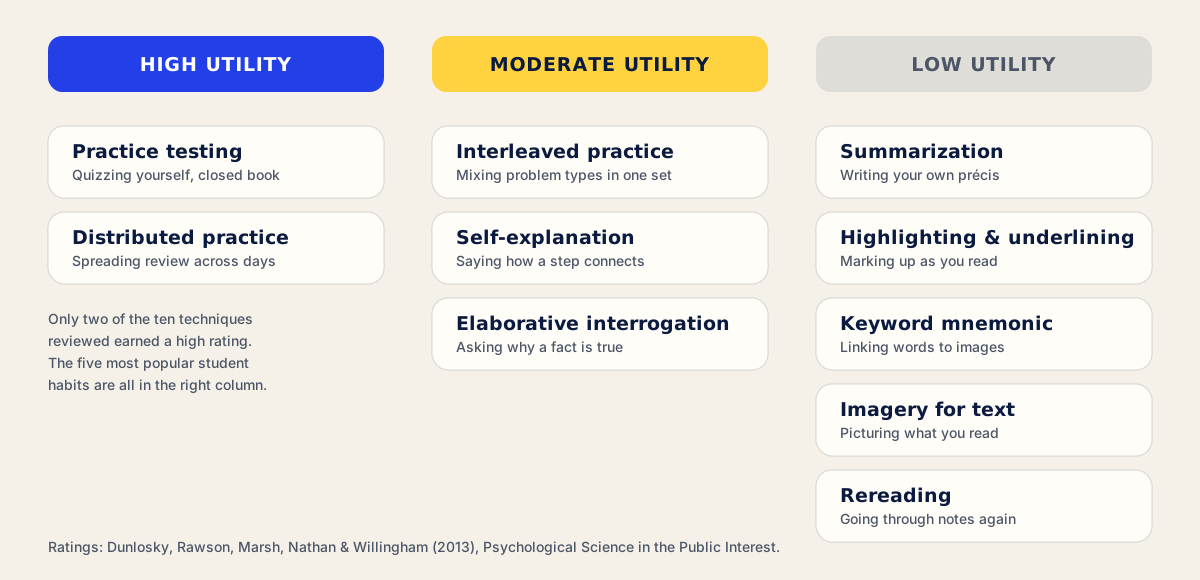
Nothing in the low column is harmful. Rereading and note-taking feel like work because they are work. They are simply weak relative to the alternatives, and they consume the hours the evidence-based techniques need. That is the real cost of the wrong study strategies: not failure, just a week spent at 40% efficiency.
1. Active recall: answer before you look
Active recall means you retrieve the information from memory rather than recognise it on a page — actively engaging with the material instead of passively reading it again. Close the notes, write down everything you can, then check. Every successful attempt strengthens memory for the next one.
It is one of the most effective things you can do with an hour, and the cleanest demonstration is Roediger and Karpicke (2006). Students read a prose passage and then either reread it repeatedly or took free-recall tests with no feedback at all. When tested five minutes later, the rereading group won. When tested a week later, the result reversed completely.
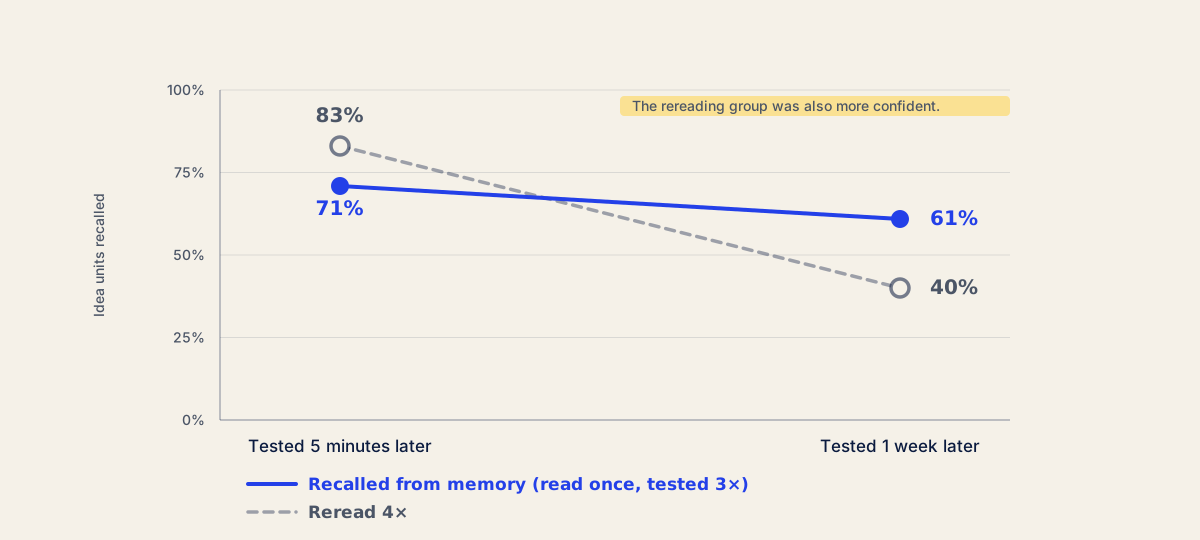
Two details matter more than the headline. The tested group got there on roughly a quarter of the reading. And the rereading group reported higher confidence in how much they would remember. Passively rereading textbooks produces fluency, fluency feels like knowledge, and the feeling survives right up until the exam.
The simplest way to put this into practice has a name now — it is the blurting method, which is free recall with a gap-check bolted on.
The classroom evidence is now substantial. A 2021 systematic review screened nearly 2,000 abstracts and coded 50 experiments run in real schools with 5,374 students. Of the 49 effect sizes, 57% showed a medium or large benefit and only three were negative. One honest caveat the authors raise themselves: just 6% of those experiments came from outside wealthy Western countries.
Flashcards are the most common implementation and the easiest to get wrong. Turning a card over and thinking I knew that is recognition, not recall. The card only counts if you produced the answer out loud or on paper first. Blank-page recall has no such failure mode, which is why it is the version worth starting with.
After any lecture or chapter, shut everything and write what you remember on a blank page. Then open the source and mark what you missed. The missed items are your study list; the rest is already done.
2. Spaced repetition: widen the gaps deliberately
Distributed practice is the second high-utility technique. The same total hours, split across more study sessions on different days, produce better long-term retention than the same hours in one sitting. Reviewing material at increasing intervals works because each gap lets a little forgetting set in, and effortful recall after partial forgetting is what does the work.
One misconception is worth clearing up, because nearly every article on this topic repeats it. The claim that “we forget 70% within 24 hours” is not what Ebbinghaus measured. He measured savings — how much relearning time is saved on a second pass — and the 2015 replication put savings at 31.7% after a day, against Ebbinghaus’s own 33.7%. That is one participant memorising nonsense syllables, not a law governing your biology lecture. The spacing effect is real and well replicated; this particular statistic is just repeated carelessly.
Practically, the exact interval matters less than the apps imply. What you need is more than one session, separated by at least a night, where each one begins with an attempt to recall information rather than review it. Techniques like spaced repetition scheduling in Anki automate this, but a sheet of paper with four dates on it captures most of the benefit. The point is retaining information for the next exam instead of cramming it for this one.
3. Practice testing: go to past exam papers early
This is the same mechanism as active recall aimed at a specific target. Past papers and practice tests tell you the format, the phrasing, and the depth a real exam expects — information no textbook contains.
The counterintuitive part is the timing. Most students save past papers for the final week as a readiness check. Use them from the start, when they are still uncomfortable and you cannot answer half of them. A paper you score 30% on in week one is a diagnostic that reshapes everything you do next; the same paper in the last week is just anxiety with a timer. Nothing improves exam performance faster than discovering in week one which questions you cannot yet answer.
4. Interleaved practice: stop studying one thing at a time
Interleaving means arranging practice so consecutive problems need different strategies. Most textbooks do the opposite: twenty problems of one type, so you stop reading the question and start pattern-matching the layout. Mixing different topics into the same problem sets forces you to identify the problem before solving it, which is the harder half of problem-solving.
Rohrer and colleagues (2020) ran a preregistered cluster randomised trial across 54 seventh-grade maths classes. Both groups did the same problems over four months; only the order differed. On an unannounced test a month later the interleaved group scored 61% against 38%, with an effect size of d = 0.83, and the benefit appeared in all fifteen teachers’ classes.
61% vs 38%
interleaved against blocked practice, one month after the last session
d = 0.83
effect size — large, from 787 students across 54 classes
15 / 15
teachers whose classes showed the effect
It is a powerful technique that feels worse while you do it. You make more errors, progress is slower, and the session ends without the satisfaction of a completed block. That discomfort is the mechanism: you are practising the choice of method, which is what an exam actually tests.
5. Self-explanation: the Feynman technique for deeper understanding
Being able to explain a concept in plain language exposes the joints in your understanding. The technique gets attached to Richard Feynman’s name, and the underlying research holds up at moderate strength — self-explanation improves comprehension and transfer, though the evidence across long delays is thinner.
Two rules keep it honest. Explain a concept from memory, not while reading, or you are paraphrasing rather than explaining. And say why a step follows, not just what the step is. “Then you divide both sides” is narration. “You divide because the variable is being multiplied, and division undoes that” is an explanation, and it is the version that produces a deeper understanding of a complex topic rather than a memorised sequence.
The points where your sentence stalls are knowledge gaps, and they are worth more than any highlighted page: they tell you exactly which key concepts to go back to. Teaching others works for the same reason, with a useful side effect — a real person interrupts when you skip something, which helps solidify the parts you were quietly gliding over.
6. Sleep: the memory consolidation you cannot skip
Sleep is when the brain consolidates what you studied. It is also the first thing students trade away, usually in the week when memory consolidation matters most.
The practical version is simple. If you space study across days, you get the benefit automatically — the night between sessions is doing work, and you arrive at the next session well-rested enough to do real recall rather than staring at a page. If you compress everything into one long night, you lose the spacing and the consolidation together. Last-minute cramming has this built in: an all-nighter is not a neutral trade of rest for hours, it removes the process that turns encoding into durable memory. Being well-rested is not a wellness tip here, it is part of the method that lets you consolidate memories at all.
Daytime naps do a compressed version of the same job, and the length decides which job you get: ten minutes buys alertness, thirty buys encoding. The trial that separates them is in best nap length for studying.
7. Calibration: predict your score before you check it
This is the genuinely underused one, and it is what makes the other six self-correcting.
Before you mark a practice set, write down the score you expect. Then mark it. The gap between prediction and reality is the single most useful number in your revision, because almost all wasted study time goes on material you already know while feeling productive.
Students are reliably bad at this, and the bias runs one way. In the Roediger and Karpicke study, the group that remembered least was the most confident. Spaced maths practice has been shown to reduce overconfidence as well as improve scores. What top students tend to have is not better memory but better calibration — they know which topics are weak, so their study strategies point somewhere useful. Track the gap for two weeks and it closes; students who close it achieve higher scores for the unglamorous reason that they stop revising what they already know.
Three methods that make every list but not the evidence
Mind mapping. Diagramming related ideas is a reasonable way to organise complex information, but it is not a strong memory technique. In Karpicke and Blunt (2011), published in Science, students who studied with concept mapping were outperformed on a later test by students who simply practised retrieval — and the students themselves predicted the opposite result. Imagery-based techniques sit in Dunlosky’s low-utility column for related reasons.
The Pomodoro technique. Twenty-five minutes on, five off, is a sensible way to start working when procrastination has the upper hand. It has essentially no peer-reviewed evidence base as a learning technique, and it is orthogonal to everything above: a pomodoro spent rereading is still a pomodoro spent rereading. Use it to begin study sessions, not to decide what happens inside them.
Learning styles. The idea that you are a visual or auditory learner and should be taught accordingly was reviewed by Pashler and colleagues (2008), who found “virtually no evidence” for it. People do have presentation preferences; matching teaching to those preferences does not improve outcomes. Studying a diagram-heavy subject with diagrams is fine. Avoiding practice problems because you are “not a logical learner” is not. The whole literature on this, and the handful of findings that survive it, is in our guide to learning methods.
What is the 9-8-7 rule for studying?
It usually means a daily split for intensive exam periods: 9 hours studying, 8 hours sleeping, 7 hours for meals, exercise, and everything else. A second, unrelated 9-8-7 method describes a short cycle of roughly nine, eight, and seven minutes for preparing, studying, and resting, so check which one someone means.
Neither has research behind it. The part worth keeping is the 8 hours of sleep, and the useful idea underneath is that study hours have a ceiling. Nine hours of interleaved retrieval is a serious day. Nine hours of highlighting is a serious day of nothing.
How to focus 100% while studying
Focus advice is mostly environmental, and the honest answer is that no study environment substitutes for having a specific task.
Vague intent is what phones exploit. “Study biology” has no finish line, so any interruption is free. “Answer these twelve questions from memory, then mark them” has a clear end, and checking a notification visibly costs you something. Decide the task first; then improve focus by removing friction — notifications off, headphones if the room is noisy, and a study space that is not the one you sleep in. Study groups help once you have a strong foundation of your own and can ask relevant questions; before that they mostly redistribute confusion.
If the problem is not one session but ten hours of them back to back, the constraint is different and so is the fix: see how to study for long hours.
A two-week study schedule that uses all seven
Effective study is less about the list of techniques than about the order you apply them in. Here is the smallest schedule that contains all seven.
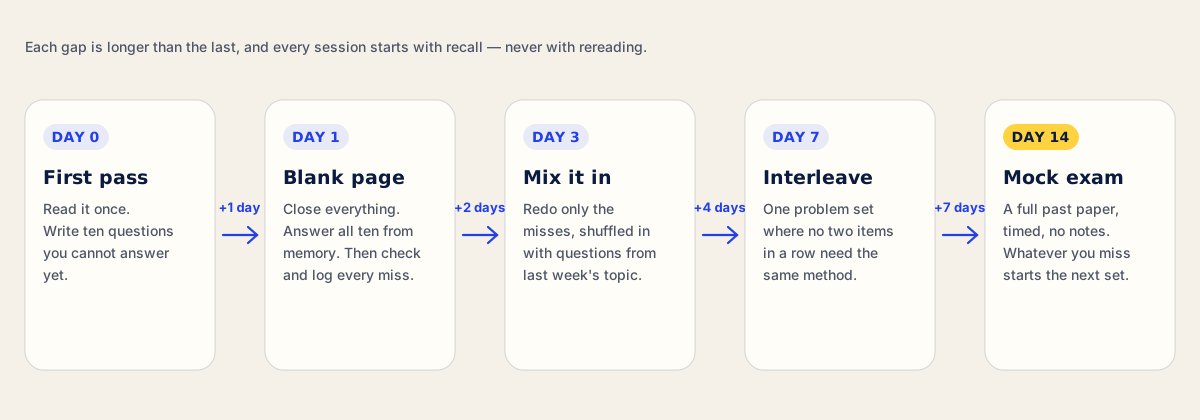
Calibration runs underneath all of it: predict the score before you mark anything. Sleep runs underneath too, in the sense that the gaps only work if you actually sleep through them.
Where AI summarizing fits — and where it quietly hurts
This is a document tool’s blog, so the temptation is to tell you that summarizing your reading is a study method. It is not. Summarization sits in the low-utility column of Dunlosky’s review, and reading a good summary produces exactly the fluency illusion that made the rereading group overconfident.
What it is genuinely good for is triage. Before a module you are facing 400 pages of slides, chapters, and papers, and the expensive question is not how to memorise them but which forty pages actually matter. That is a sorting problem, and it is the one worth automating.
- 1
Map the material before you touch it
Run a chapter or a lecture deck through a summarizer to see its structure and main claims. Five minutes here stops you spending a week on a section worth four marks.
- 2
Turn the key concepts into questions, not notes
Take each point and rewrite it as something you have to answer. This is the step that converts a passive summary into retrieval practice — and it is the step people skip.
- 3
Close the summary and answer from memory
The summary has done its job once the questions exist. Everything after that has to happen with the document shut, or you are back to rereading.
Most of what needs triaging at this stage is lecture slides, and slides are the worst format to triage by hand — forty screens of fragments with the argument spread across them. Drop the deck into our PowerPoint summarizer and you get the thread of the lecture in a few lines, which is enough to write questions against. Chapters and papers go through the PDF summarizer the same way. Both are free and need no account, which matters when the alternative is a subscription on a student budget.
For the wider question of what is worth automating in a study system, we ranked the options in best AI study tools.
One caution worth repeating from our guide to summarizing a PDF: summaries fail quietly. A date slips, a negation disappears, and the prose stays confident. Anything you intend to write in an exam should be checked against the source once.
Frequently asked questions
What are the 7 secret methods for studying?
Active recall, spaced repetition, practice testing with past papers, interleaving, self-explanation, protecting sleep, and calibrating your confidence against your actual scores. The first three have the strongest evidence behind them; the seventh is the one that tells you whether the other six are working.
Which study technique has the strongest evidence?
Practice testing and distributed practice. They were the only two of ten techniques to earn a high utility rating in the 2013 review by Dunlosky and colleagues, because their benefits hold across ages, subjects, materials, and long delays.
What are the secret methods for studying effectively in less time?
Replace rereading with recall and spread the same hours across more days. In the Roediger and Karpicke experiment the tested group read the passage 3.4 times and the rereading group read it 14.2 times, yet the tested group remembered half again as much a week later. Fewer hours, better placed, beats more hours.
Is cramming ever worth it?
For an exam tomorrow, cramming beats nothing and will get you through. It performs badly on anything more than a few days out, and it teaches nothing that survives into the next module. If you have a week, spacing the same hours across it wins comfortably.
How long before these methods start working?
Retrieval practice shows up within days, and the gap between it and rereading widens with time, so a one-week delay makes the difference obvious. Interleaving is slower and feels worse at first; the randomised trial that found a 61% to 38% gap ran for four months before testing.
Can I use an AI summarizer instead of reading the material?
Not as a replacement. A summary tells you what is in a document and which parts deserve attention, which saves real time on long reading lists. It cannot do the retrieval step for you, and reading one makes you feel more prepared than you are. Use it to decide what to study, then close it and answer from memory.
How many study methods should I use at once?
Two, to start. Active recall and spacing cover most of the available benefit and combine into a single habit: answer from memory, at widening intervals. Add interleaving once that is automatic, and add past papers as soon as you can get hold of them.
The 7 secrets, in short
“Study smarter, not harder” is the usual advice, and it is useless without a list of what smarter means. Here it is: the effective methods feel worse than the ineffective ones while you are doing them. Rereading is smooth and produces confidence. Retrieval is halting and produces accuracy. Blocked practice feels like progress. Interleaved practice feels like failure and scores 23 points higher a month later.
No single technique will ace your exams. But if you pick the uncomfortable option, protect the sleep between sessions, and check your predicted score against the real one often enough that you cannot fool yourself, you will spend fewer hours studying and remember more of it.