Search for learning methods and you will be handed a quiz. Four or eight boxes, a short questionnaire, and a verdict: you are a visual learner, or an auditory one, or kinesthetic. Then a list of things people like you should do.
It is a genuinely appealing idea, and it is taught to teachers, printed in textbooks and built into training software. Most people who believe in learning styles were told about them by someone they had good reason to trust. It is also the most thoroughly tested idea in education that has never once produced the result it promises.
That sentence needs care, because the debunking is usually done badly. Learning preferences are real. People do prefer diagrams to lectures, and those preferences are stable enough to measure. What has failed, repeatedly and under exactly the conditions its own proponents specified, is the step that matters: the claim that teaching someone in their preferred format makes them learn more. Researchers call this the meshing hypothesis. Every well-designed test of it has come back negative.
So this guide does two things. It explains the learning styles models properly — what each one claims, where it came from, and what it is good for — because you cannot evaluate an idea you only half understand. Then it covers the learning methods that do hold up, which turn out to have nothing to do with what kind of learner you are.
Learning methods and learning styles are two different questions
Most of the confusion in this topic comes from one word doing two jobs.
Learning styles are a claim about people: that learners can be sorted into types of learners by how they best receive information, and that instruction should be matched to the category. Learning style theory treats your dominant learning style as a stable property of you, and asks teaching methods to accommodate it. The unit of analysis is the person.
Learning methods are a claim about activities: that some things you can do with material produce more durable knowledge than others. Retrieving from memory beats rereading. Spacing beats cramming. Explaining beats highlighting. The unit of analysis is the activity.
Learning style theory and the study of the learning process are not competing theories, they are different levels of description — and almost all of the evidence in education sits at the second level while almost all of the popular content sits at the first. That mismatch is the whole story.
It matters practically, too. If the style claim were true, the most valuable thing a student could do is identify their preferred learning style and then filter all future material through the result. If the methods claim is true, the questionnaire is irrelevant and the valuable thing is changing what you do at your desk on Tuesday evening. Those lead to completely different behaviour.
The main four types of learning: what the four main learning styles claim
The framework behind nearly every online quiz is VARK, devised by New Zealand teacher Neil Fleming in 1987. It proposes four learning styles—visual, aural, read/write and kinesthetic—as four types of learning preference. Fleming’s own term is “modal preference” — a preference for a stimulus modality, not a diagnosis.
- 1
Visual
Prefers information presented spatially: a diagram, a graph, a flow chart, a map. Note that Fleming's visual category is specifically about symbolic and spatial representation, not about pictures or video in general, and not about reading.
- 2
Aural or auditory
Prefers information heard or spoken: lectures, discussion, explaining out loud, recordings. Group work and talking things through fall in this category.
- 3
Read/write
Prefers information as words on a page: textbooks, lists, notes, written definitions, essays. This is the category most conventional education is already built around.
- 4
Kinesthetic
Prefers information connected to experience and practice: experiments, worked examples, simulations, doing the thing. Fleming defines this as a preference for concrete, real examples rather than as a need to physically move.
A fifth option, multimodal, covers people who score across several categories — and in practice most people do, which means a combination of learning styles is the norm rather than a single specific learning style. Multiple styles, not one. That detail is routinely dropped from the popular versions, which is the first sign that the four main learning styles are being used less as a description and more as a horoscope.
It is worth being fair to Fleming here. VARK learning styles were designed as a conversation-starter to get students reflecting on how they study, and much of the strong causal language attached to it came later, from other people, often from people selling something.
Visual learning, auditory learning and kinesthetic learning in practice
Because these categories are so widely used, here is what each one typically recommends, stated as its advocates state it.
Visual learning means converting material into spatial form: mind maps, timelines, colour-coded notes, visual aids such as a diagram of a process instead of a paragraph describing it. The recommendation is to redraw rather than reread.
Auditory learning means turning material into speech: recording summaries and replaying them, joining a study group for collaborative learning, reading notes aloud, explaining a topic to someone who does not know it. Auditory learners are told that hearing beats reading for them.
Kinesthetic learning means working through instances: doing past paper questions rather than reviewing worked solutions, running the experiment, building the model, using physical objects to stand in for abstract relationships. The somatosensory system gets invoked a lot in popular explanations, usually without justification.
Now here is the interesting part, and it is the reason this article is not simply a debunking. Look at what is actually being recommended. Drawing a process diagram is a form of elaboration. Explaining a topic aloud is self-explanation. Doing past paper questions is retrieval practice. Every one of those is an evidence-backed learning method in its own right, effective for essentially everybody.
So students who follow learning styles advice often do improve their learning — not because the advice matched their particular learning style, but because almost any of these activities beats the thing they were doing before, which was usually rereading a highlighted textbook. The framework gets the credit that belongs to the activity. This is the single biggest reason people are confident they have seen evidence for learning styles working.
Are you a visual, auditory or kinesthetic learner? What the quiz actually measures
A VARK questionnaire measures a real thing: your stated preference. Ask someone whether they would rather be handed a diagram or a recording and they will answer, the answer will be reasonably consistent if you ask again later, and it will feel accurate.
What it does not measure is aptitude. Being labelled a kinesthetic learner tells you nothing about whether you comprehend better from doing than from reading, because the questionnaire never tested your comprehension. It asked what you like. A learning styles inventory is a preference survey wearing the costume of a diagnostic test.
This is the gap that everything else in this article sits in. Preference and performance are separate variables, and the assumption that they line up is exactly the assumption that has been tested and failed. Rogowsky and colleagues checked the first half of it directly and found no statistically significant relationship between people’s auditory or visual preference and their actual listening or reading comprehension aptitude. The preference simply did not predict the skill.
There is a further problem worth naming: the categories do not survive contact with subject matter. As Philip Newton, who has studied educator belief in this idea, puts it, you cannot teach medical students to recognise different heart sounds visually, or teach them to identify skin rashes through audio. Some content has an inherent modality. The mode is set by the material far more often than by the learner.
Beyond VARK: Kolb’s experiential learning and the Index of Learning Styles
VARK dominates the internet, but it is not the most academically serious model, and a proper account of learning methods needs the others.
David A. Kolb’s experiential learning theory (1984) is the most influential learning style model of the serious ones. Kolb describes learning as a four-stage cycle: concrete experience, reflective observation, abstract conceptualisation, and active experimentation. You have an experience, you think about it, you form a general principle, you test the principle. His Learning Style Inventory then positions people according to which parts of that cycle they favour, producing four styles: Diverging, Assimilating, Converging and Accommodating.
Kolb’s cycle is genuinely useful as a description of how skill develops, especially in professional and workplace training, and it deserves better than to be lumped in with quiz culture. The weaker part is the inventory that sorts people, which has a long history of psychometric criticism.
Honey and Mumford adapted Kolb for management training, renaming the four positions Activist, Reflector, Theorist and Pragmatist. Their Learning Styles Questionnaire remains common in corporate settings. Independent testing found internal consistency between 0.52 and 0.78, against 0.8 as the usual acceptable threshold, and researchers were unable to recover the four proposed styles through factor analysis at all.
The Index of Learning Styles, developed by Richard Felder and Barbara Soloman from the Felder-Silverman model, is aimed at engineering education and uses four dimensions rather than categories: active/reflective, sensing/intuitive, visual/verbal, sequential/global. Felder himself has been notably careful about interpretation, emphasising that the index describes tendencies rather than fixed types and that instruction should be balanced across dimensions rather than matched to individuals. That is a meaningfully different claim from the one the quizzes make.
Alongside these sit cognitive style models, which are a distinct research tradition. Cognitive styles include Riding’s wholist-analytic dimension, Pask’s holist and serialist strategies grounded in holism, and Allinson and Hayes’ Cognitive Style Index. These describe habitual ways of processing information rather than sensory preferences, and as we will see, they have generally fared better under scrutiny.
Gardner’s theory of multiple intelligences is frequently folded into lists of “the 8 learning styles” — this is a straightforward error, and Gardner has spent years saying so. In an essay published by the Harvard Graduate School of Education he wrote that the tendency to collapse multiple intelligences into learning styles had “driven me to distraction.” His theory is about relatively independent kinds of ability, not about preferred modes of instruction, and he is openly sceptical of learning styles as a concept.
How many types of learning styles are there?
There is a precise answer, and it is not four, or seven, or eight.
In 2004 Frank Coffield and colleagues carried out the only comprehensive systematic review of the field, commissioned by the UK’s Learning and Skills Research Centre and published as Learning Styles and Pedagogy in Post-16 Learning. They set out to catalogue every learning styles model in the literature and assess the major ones against four minimum psychometric standards: internal consistency, test-retest reliability, construct validity and predictive validity. These are the basic checks any instrument must pass before anyone redesigns teaching around it.
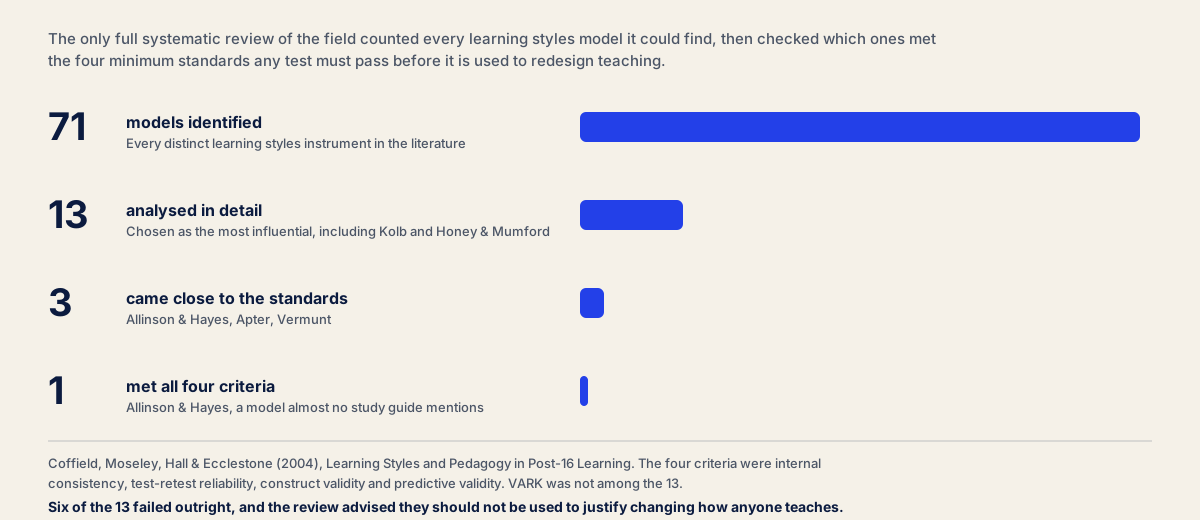
They found 71 distinct models. Thirteen were judged influential enough for detailed analysis, including Kolb, Honey and Mumford, Dunn and Dunn, Gregorc, Myers-Briggs and Sternberg.
Of those thirteen, only three — Allinson and Hayes, Apter and Vermunt — came close to meeting the four criteria, and only Allinson and Hayes met all four. Three more met two of the four. Six failed, and the review concluded that they “should not be used as the theoretical justification for changing practice.”
Two things stand out. First, the one model that passed is a cognitive style measure that almost no study guide has heard of. Second, VARK is not among the thirteen at all — learning styles such as VARK, which dominate every search result for this topic, were not considered influential enough in the academic literature to warrant detailed review.
Coffield’s team also made an observation that explains a lot about why this topic is so noisy: the field splits into three activities — theoretical, pedagogical, and commercial — and the commercial branch has by far the strongest incentive to keep the categories simple and the questionnaires short.
Does matching teaching strategies to different learning styles work?
This is the question that actually matters, and it has a specific technical form.
In 2008, Harold Pashler, Mark McDaniel, Doug Rohrer and Robert Bjork reviewed the evidence in Psychological Science in the Public Interest and pointed out that almost none of the existing research was designed to answer it. To support matching, you need a particular result: an interaction. Learners of style A must do better with method A than method B, and learners of style B must do better with method B than method A. A crossover.
Just showing that one group scored higher overall is not enough — that is a main effect, and it means some material or method is simply better for everyone, regardless of style of learning. The crossover is what “match the teaching to the learner” predicts, and it is the only thing that would justify the practice.
Pashler and colleagues found that the overwhelming majority of studies did not use a design capable of detecting an interaction, and that among the handful that did, the results contradicted the hypothesis. Their conclusion was that there was no adequate evidence base to justify the use of learning styles in education, and that given the costs involved, the money would be better spent elsewhere. Their review is indexed by the United States National Library of Medicine alongside the experiments that followed it.
That was a review, not an experiment. So people ran the experiment.
The experiment that tests the auditory learning style directly
Pashler’s paper included a specification for how a proper test should be built. Rogowsky, Calhoun and Tallal followed it.
They took college-educated adults and established each person’s auditory or visual-word preference using a standardised adult learning styles inventory, giving each participant a dominant learning style across the two learning modalities being compared. Participants then received the same material from the same non-fiction book, randomly assigned to one of two formats: a digital audiobook, or an e-text. Everyone took the same written comprehension test immediately, and again two weeks later.
If the auditory learning style meant anything operationally, auditory-preference participants should have done better with the audiobook and visual-preference participants better with the e-text. That is the crossover.
There was no statistically significant interaction between preference and format — not on the immediate test, and not after two weeks. A follow-up study adding a dual-modality condition, where participants read and listened simultaneously, found no significant differences between any of the three formats either.
These are moderate-sized studies, and absence of evidence is not proof of impossibility. It remains conceivable that some narrower version of matching works in some specific context nobody has tested well yet.
But the burden of proof sits with the claim, not against it. Learning styles are not a tentative hypothesis awaiting investigation — they are embedded in teacher training, curriculum design and commercial products worldwide, on the strength of evidence that does not exist. After more than fifteen years of targeted testing following a published specification, repeated failure to find the effect is the relevant fact.
Why teachers still support different learning styles
Here the research gets genuinely uncomfortable.
Newton and Miah surveyed 114 academics working in teaching in higher education and published the results in Frontiers in Psychology. Belief in learning styles ran at 58%. Only 33% reported that they actually used learning styles in their teaching, and far more reported using techniques that are demonstrably evidence-based. When presented with the weaknesses of the theory, 90% agreed that it is conceptually flawed.
And 32% said they would keep using it anyway.
A later systematic review by Newton and Salvi widened the lens considerably: 37 studies, 15,405 educators across 18 countries, from 2009 to early 2020. Self-reported belief in matching instruction to learning styles in the classroom averaged 89.1%, ranging from 58% to 97.6% depending on the sample. Belief in learning styles was, if anything, strongest among the least experienced. Among trainee teachers — people currently being prepared to teach — it was 95.4%. There was no evidence of the belief declining over that decade.
89.1%
of 15,405 educators believe matching instruction works
95.4%
of trainee teachers agree with it
37 pts
average drop in belief after being shown the evidence
The last figure is the hopeful one: targeted educational interventions reduced self-reported belief by an average of 37 percentage points. The idea is correctable. It is just not correcting itself.
Why does it persist? Partly because it is kind — it tells every struggling student that they are not bad at learning, they have simply been taught wrong, and that is a much better story than the alternatives. Partly because, as noted earlier, the recommended activities often work for unrelated reasons, so people have genuine success to point to. And partly because it gets conflated with much better ideas, like using a variety of teaching methods, or designing a curriculum that is accessible to different people. Understanding different learning needs in a classroom is sound teaching practice. It is not the meshing hypothesis, and the two get filed together constantly.
What decides student learning: the learning strategies that help you learn best
If the sorting is not the answer, what is?
The most useful map is Dunlosky and colleagues’ 2013 review in Psychological Science in the Public Interest, which assessed ten common learning strategies against criteria including how well they generalise across materials, students, and test types. Two came out with high utility: practice testing and distributed practice. Three were moderate: elaborative interrogation, self-explanation, and interleaved practice. Five were low, including two of the most popular things students do — highlighting and rereading.
The important property of that list is that the rankings are not conditional on who you are. Retrieval practice works for the visual learner and the auditory learner and the person who never took the quiz. It works because of how memory and the learning process function, not because of how you like to receive information. Individual learning still varies, but it varies in how much practice someone needs, not in which method helps them.
We cover how to run each of these in our guide to seven evidence-backed study methods, and the purest form of retrieval practice — writing down everything you know from an empty page before checking — in the blurting method.
Active learning: the approach to learning with the strongest evidence
At the level of teaching rather than studying, one finding dominates.
Scott Freeman and colleagues meta-analysed 225 studies comparing traditional lecturing with active learning in undergraduate science, technology, engineering and mathematics courses. Active learning here means anything that requires students to do something with the material during class — solve problems, discuss, predict, answer questions — as opposed to listening and taking notes.
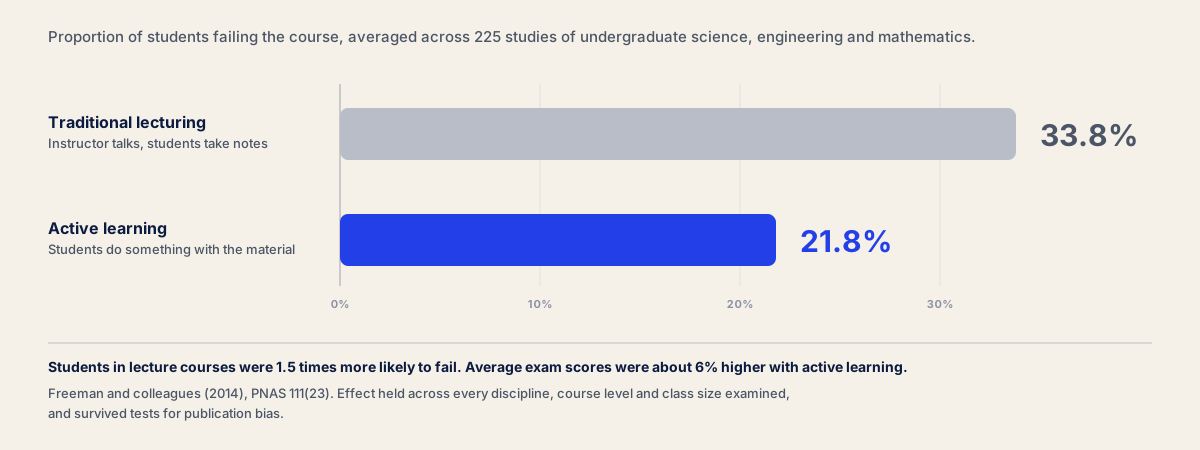
Performance on exams and concept inventories rose by 0.47 standard deviations. Average failure rates fell from 33.8% under lecturing to 21.8% under active learning — students in lecture courses were 1.5 times more likely to fail. The effect held across every STEM discipline, every course level and every class size studied, with the largest gains in classes of 50 or fewer, and it survived formal tests for publication bias.
Notice what this result is not. It is not about matching anything to anyone. It is a single change in what happens during the hour, applied identically to everybody, producing an effect on academic achievement far larger than anything learning styles research has ever reported. Teaching and learning improved together, without anyone being sorted first.
Students feel they learn less when they learn more
There is one more result, and it explains why the wrong ideas in this field are so sticky.
Deslauriers and colleagues ran a randomised experiment in introductory physics at Harvard. In week 12, half the class was assigned to an active learning session and half to a polished lecture by an experienced, highly rated instructor. The following class, the groups swapped. Identical content, identical handouts, random assignment, and no attempt to sell either approach.
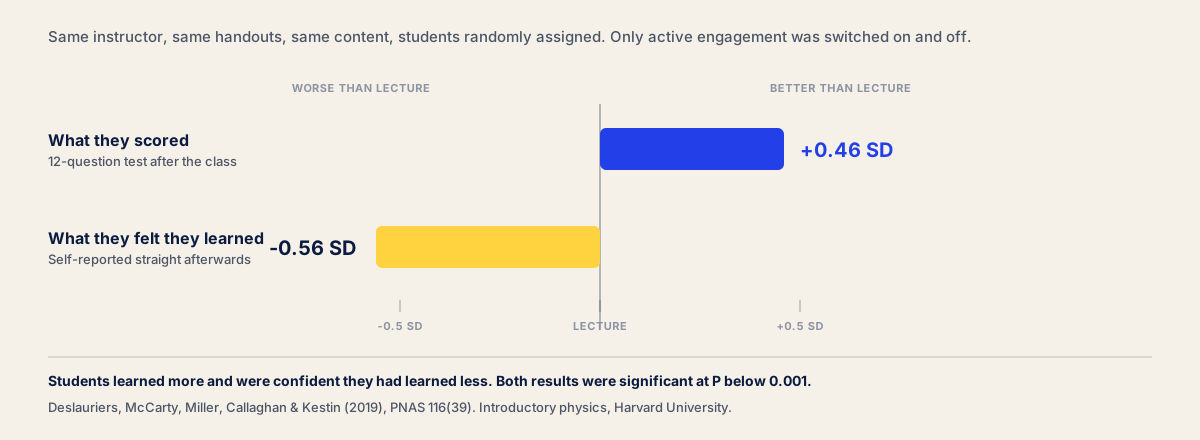
Students in the active sessions scored 0.46 standard deviations higher on the test. They also rated their own feeling of learning 0.56 standard deviations lower. Both results were significant well beyond the conventional threshold.
The authors attribute the gap largely to cognitive effort. A polished lecture is fluent: it goes down easily, nothing snags, and that smoothness registers as understanding, and as confidence. Active learning is effortful and full of small failures, and students read that friction as evidence they are not learning. The data say the opposite.
This is the same mechanism that keeps learning styles alive. Material delivered in your preferred format feels easier. Easier feels like better. It usually is not — a large body of work on what Robert Bjork calls desirable difficulties points the other way, and we look at how badly students misjudge their own progress in our piece on studying for long hours.
If you take one transferable idea from this article, make it this: your sense of how well a study session went is a poor instrument, and it is biased in a predictable direction. Test yourself instead of consulting your feelings.
Types of learning in education: sort by type of learning, not by learner
If sorting people is the wrong move, sorting situations is not. Here are the distinctions that carry real weight, and none of them are about learner types.
- 1
By what the knowledge is for
Declarative knowledge (facts, definitions, relationships) responds to retrieval practice and spacing. Procedural skill responds to repeated practice with feedback. Conceptual understanding responds to explanation and contrasting cases. Using the wrong method for the target is a far more common mistake than using the wrong modality.
- 2
By how structured it is
Formal learning follows a curriculum and an assessment. Non-formal learning is organised but not accredited, like a workshop or a short course. Informal learning is the unplanned majority — a colleague's feedback, a problem you had to solve. Most workplace capability comes from the third category and almost no one designs for it.
- 3
By delivery format
In-person, online, blended, and microlearning. This is the axis corporate training discussions usually mean by learning methods, and the honest summary is that format matters much less than what the format asks learners to do. A passive workshop and a passive video are both passive.
- 4
By who directs it
Instructor-led versus self-directed. Self-direction demands accurate self-assessment, which, as the Harvard result shows, most people do not have by default. This is why self-directed learners benefit disproportionately from building in tests they cannot talk themselves out of.
Popular learning methods and learning approaches, ranked by evidence
Bringing it together, here is the honest state of play across the popular learning method categories.
Strong evidence: retrieval practice and testing; distributed practice; active learning in the classroom; feedback; explaining material to yourself or others; collaborative learning where the group has to produce something rather than just discuss.
Moderate or promising evidence: interleaving different problem types; elaborative interrogation; worked examples for beginners moving to independent problems later; dual coding, meaning words and relevant visuals together — which is a real effect, and importantly it works for everyone, not just “visual learners.”
Weak or no evidence: matching instruction to a student’s learning style; rereading; highlighting; summarising as typically performed by students; and the various learning style models used as diagnostic tools rather than as prompts for reflection.
Since dual coding and first-pass orientation come up above, it is worth being precise about where a tool like ours belongs.
Reading a summary is passive. It is not a learning method and it will not put anything in long-term memory on its own. What it does well is compress the least valuable part of studying: the slow first read where you are working out what a document contains and which parts deserve real attention.
That is the job our PDF summarizer does — upload a chapter or a paper, get the structure and the main claims quickly, then spend the time you saved on retrieval practice, which is the part that actually works. Set texts and long reading lists go through the book summarizer instead, which reads EPUB and MOBI directly. If you use either one to replace the thinking rather than the triage, it will hurt you, and the research on that is reasonably clear too.
Different ways of learning still matter, just not as a filing system
It would be a mistake to read all this as “everyone is the same, teach everyone identically.” Learners differ enormously, and those differences have real consequences. They are just not the differences the quiz measures.
What demonstrably varies between learners and affects outcomes:
- Prior knowledge. By a wide margin the strongest predictor of how someone will handle new learning. The same explanation that helps a novice can slow down an expert, an effect well documented in instructional design. This is the real source of most learning differences between two students in the same room.
- Working memory capacity. Affects how much a person can hold at once, and therefore how material should be chunked and paced. This is a genuine constraint on cognition, and unlike a style label it tells you exactly what to change.
- Motivation and mindset. Affects persistence, which affects total practice, which affects everything downstream.
- Language proficiency. Linguistics matters here in a way that is often mistaken for a processing preference when material is delivered in a second language. A child who needs the diagram may need it because of vocabulary, not modality.
- Cognitive style. Habitual ways of approaching problems, such as the wholist-analytic dimension, which sit on firmer psychometric ground than sensory-modality styles.
These are harder to measure than a four-item quiz, and the data on them do not yield a tidy label. That is precisely why the tidy label won. Each of them also suggests a concrete way to enhance learning, which a style label never does.
How to plan for diverse learning needs without sorting students into boxes
For a teacher, trainer or anyone designing a learning experience, the practical replacement for style-matching is well established and not controversial.
- 1
Present in multiple formats for everyone
Not because individuals need their format, but because most concepts are better understood from more than one angle, and because words paired with a relevant diagram beat either alone. Use a variety of teaching methods across the group rather than assigning a teaching style per student.
- 2
Build retrieval into the session
Low-stakes questions, predictions before demonstrations, a two-minute written recall at the end. This is the highest-return change available and it costs almost nothing.
- 3
Let the content choose the modality
Heart sounds are auditory. Molecular geometry is spatial. Pipetting is kinesthetic. Fighting the inherent modality of the material to satisfy a learner label is the one genuinely harmful version of this idea.
- 4
Design for access, not for types
Captions, transcripts, readable contrast, multiple ways to demonstrate competence. This is universal design, it creates learning opportunities for everyone, and it is frequently mislabelled as learning styles. Keep the practice and drop the styles theory.
- 5
Warn people that effort feels like failure
The Harvard team found that a short explanation early in the term improved how students responded to active learning. Telling people in advance that the harder method will feel worse makes them more likely to stick with it.
What to change after the quiz
If you have taken a learning styles questionnaire and the result felt true, it probably is true — about your preferences. Keep it. Preference affects whether you sit down at all, and a method you will actually use beats a better method you avoid.
Just do not let it decide anything important. Do not skip the reading because you are “not a read/write learner,” and do not conclude a subject is closed to you because it is taught in the wrong format. There is no evidence that any of that follows.
What to do instead is unglamorous and well supported: test yourself rather than review, spread the work out rather than mass it, explain things in your own words, and treat the feeling of fluency with suspicion. The blurting method is the cheapest way to start, and we sorted the software that genuinely supports this in best AI study tools. It holds when you are learning different subjects, and it holds across many different learning situations, from a lecture hall to a kitchen table. That advice is identical for all four types, which is inconvenient for the quiz industry and convenient for you, because it means there is only one thing to learn.
What this changes for learning and teaching
None of this argues for treating a class as interchangeable. It argues for locating the differences in the right place.
A teacher who drops individual learning styles has not lost a tool. They have swapped a per-student label for questions with better answers: what does this group already know, what will they have to do with the knowledge, and how will I find out whether it landed? Those questions produce different types of learning activities for different topics, which is a more useful kind of variation than producing different formats for different people.
The learning environment matters here too, and it is one of the places where the popular advice is not wrong, just misattributed. A positive learning environment exists to help students because it lowers the cost of being visibly wrong, and being visibly wrong is a prerequisite for retrieval practice and for the kind of classroom communication that makes active learning work. That is a claim about psychological safety, not about individual styles.
The practical test is simple. If a proposed change would help everyone in the room, it is probably worth making. If it only makes sense once you have sorted people by a student learning style, the evidence related to learning says you can skip it.
Frequently asked questions
What are the four main learning styles?
The four in the VARK model are visual, aural or auditory, read/write, and kinesthetic. Visual means a preference for diagrams, charts and spatial layouts. Auditory means a preference for listening and discussion. Read/write means a preference for text. Kinesthetic means a preference for concrete examples and hands-on practice. A fifth category, multimodal, describes people who score across several — which is most people.
How many types of learning styles are there?
A 2004 systematic review by Coffield and colleagues identified 71 distinct learning styles models in the research literature. Thirteen were analysed in detail, and only one of those met all four minimum standards for reliability and validity. The familiar four-category model, VARK, was not among the thirteen.
Do learning styles actually work?
The preferences are real and measurable. The claim that matching instruction to them improves learning — the meshing hypothesis — has no supporting evidence from studies designed to test it. Controlled experiments that assigned people to matched or mismatched formats found no significant advantage for matching, either immediately or after a delay.
If learning styles do not work, why do so many teachers use them?
A systematic review of 37 studies covering 15,405 educators in 18 countries found 89.1% believed in matching instruction to learning styles, with no decline over a decade. The idea persists because it is optimistic about struggling learners, because the activities it recommends often work for unrelated reasons, and because it gets conflated with sound practices like using multiple formats and designing for accessibility.
What is the most effective learning method?
For individual study, retrieval practice — testing yourself rather than reviewing — combined with spacing that practice over time. Both were rated high utility in Dunlosky and colleagues' review of ten techniques. For teaching, active learning has the strongest evidence: a meta-analysis of 225 studies found failure rates fell from 33.8% to 21.8% and exam scores rose about 6%.
What is Kolb's experiential learning theory?
David A. Kolb proposed that learning proceeds through a four-stage cycle: concrete experience, reflective observation, abstract conceptualisation, and active experimentation. His Learning Style Inventory then classifies people by which parts of the cycle they favour, giving four styles — Diverging, Assimilating, Converging and Accommodating. The cycle is widely regarded as a useful description of how skill develops, particularly in workplace training. The inventory that sorts individuals has attracted substantially more criticism.
What is the Index of Learning Styles?
The Index of Learning Styles is an instrument by Richard Felder and Barbara Soloman, based on the Felder-Silverman model and aimed at engineering education. Rather than sorting people into types, it places them on four continuous dimensions: active/reflective, sensing/intuitive, visual/verbal, and sequential/global. Felder has emphasised that it describes tendencies rather than fixed categories and that teaching should be balanced across the dimensions rather than matched to individual students.
Why do students feel they learn less from active learning?
Because effort feels like failure. In a randomised Harvard physics experiment, students in active sessions scored 0.46 standard deviations higher than students given a polished lecture on identical content, but rated their own learning 0.56 standard deviations lower. A fluent lecture creates a sense of understanding, while the friction of active work is misread as evidence that learning is not happening.
The one thing to take away
The question “what kind of learner am I?” has occupied this field for forty years, produced 71 models, and delivered no reliable way to improve anyone’s results.
The question “what am I doing with this material?” has produced retrieval practice, spacing, and active learning — effects large enough to move failure rates by a third.
The first question is about identity and it feels important. The second is about behaviour and it is the one that pays. Change the question.