Blurting arrived through TikTok, which is usually a reason to be suspicious of a study method. This one is the exception. Strip away the name and blurting is free recall — the exact procedure that cognitive psychologists have been running in laboratories since the 1970s, and the one that won the most-cited head-to-head trial of study techniques ever published.
What the internet gets wrong is not whether blurting works. It is which part of it does the work, and why so many students try blurting once, feel worse, and go back to rereading. If you want to revise in a way that is supported by research showing real gains, this is one of the best things you can put in a study routine — provided you do the half that everybody skips.
What is the blurting method?
The blurting method is a revision technique in three moves: study a topic once, put everything out of sight, then write down everything you can remember on a blank piece of paper without looking at your notes. Afterwards you go back to your notes and mark, in a different colour, whatever you missed.
That is it. No app, no study tool, no stationery budget. It is a form of active recall — cognitive psychology calls it a free recall test, and “free” is the operative word. Nothing prompts you, so blurting forces your brain to retrieve the structure of the topic as well as its contents.
That single property is what separates it from almost everything else students do to revise. Reading a chapter again asks nothing of you; blurting is testing your memory, out loud and on paper, with the score visible.
How to use the blurting method: write down everything you remember
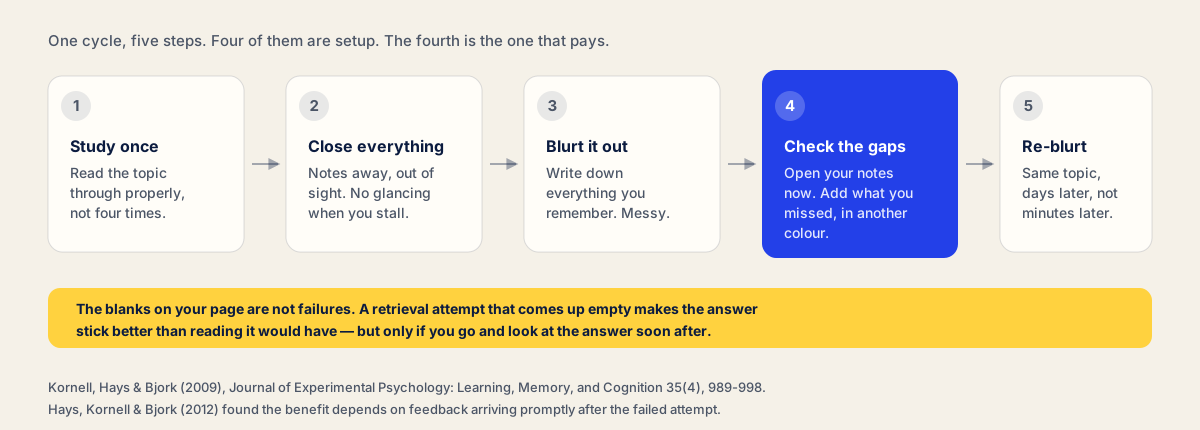
- 1
Read the topic through once, properly
Once is the point. If you reread four times before blurting you have spent your session on the weaker activity and left nothing for the stronger one.
- 2
Put the notes somewhere you cannot glance at them
Shut the laptop, turn the page over, close the tab. Peeking when you stall is the single most common way students quietly convert a blurt back into rereading.
- 3
Write down everything you remember, messily
Bullets, arrows, half-sentences, a rough mind map — whatever comes out fastest. Write down as much of the topic from memory as you can. Nobody marks the handwriting, so aim to empty your head rather than to produce a tidy page.
- 4
Open your notes and mark the gaps in a different colour
Open the source, see what you missed, and fill in the gaps in a colour that stands out. This is the step most students hurry, and it is the step the evidence says you cannot skip.
- 5
Blurt the same topic again days later, not minutes later
Repeat the process after a few days. Immediately repeating it flatters your score and teaches you little; the value comes once the material has had time to fade.
Why the blurting method works
In 2011, Jeffrey Karpicke and Janell Blunt published an experiment in Science that is, in effect, a controlled trial of blurting. Students read a science text, then either restudied it, built a concept map of it while looking at the text, or practised retrieval “by recalling as much of the information as they could on a free recall test” — blurting, with a restudy round and a second blurt.
Learning time was matched exactly. A week later everyone sat a short-answer test containing both verbatim questions and inference questions, the kind that require connecting ideas rather than parroting them.
The blurting group scored 0.67. Concept mapping scored 0.45, repeated studying 0.49, and a single read-through 0.27. The advantage held even when the final test was itself building a concept map — which is to say, blurting was better preparation for concept mapping than concept mapping was.
0.67
final test score after blurting, one week later
0.45
after building a concept map of the same text
0.27
after reading the text once
The mechanism is not mysterious, and it has a name: the testing effect. Asking your brain to recall information strengthens the route back to it. Passively rereading notes strengthens your sense of familiarity with the page, which is a different thing and is not what an exam asks for. That is the whole argument for techniques like blurting: they make the brain work to produce an answer rather than recognise one.
Why blurting works but feels worse than rereading
Here is the part that explains almost every “I tried blurting and it didn’t work” post.
In the same study, students were asked to predict how much they would remember in a week. They got it backwards. Of 120 students, 101 actually performed better after blurting — but only 30 expected to. Fifty-nine predicted the concept map would serve them better.
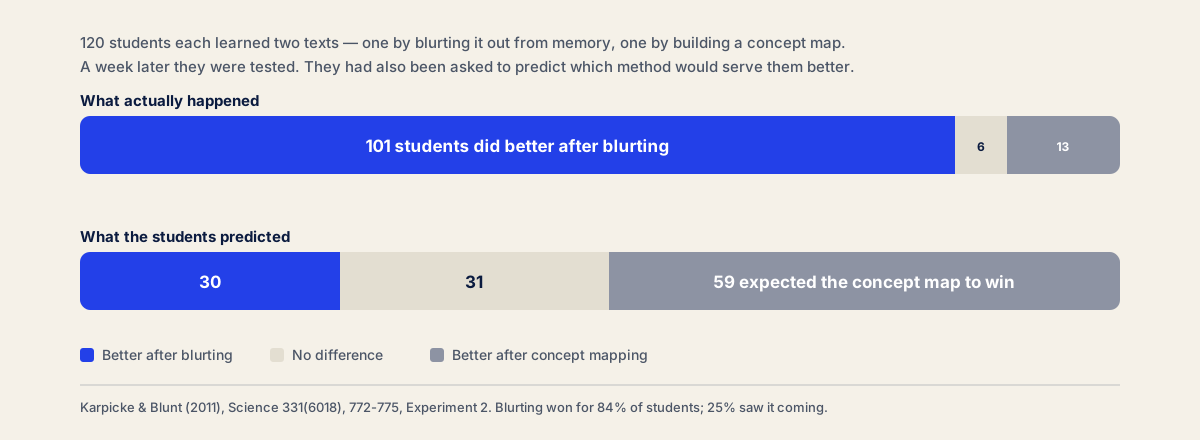
The same reversal shows up on the clock. In Roediger and Karpicke’s 2006 experiments, which also used free recall tests on prose passages, students tested five minutes after studying did worse than students who had reread: 71% against 83%. One week later the order flipped hard — 61% for the tested group against 40% for the rereading group. The rereading group had read the passage 14.2 times on average. The tested group read it 3.4 times.
So blurting genuinely does feel bad, and it genuinely does look worse if you check on the same day. Both of those are properties of a method that is working. The fluency you get from rereading is real; it just expires before the exam does.
This mistake — reading ease for learning — is the same one underneath the learning styles industry, where students pick the format that feels smoothest and conclude it suits them. We follow that thread in learning methods.
Do not judge it on how much you produced today. Judge it on how much you produce when you blurt the same topic again in a week, with nothing in between. That second number is the one that predicts your exam.
The step everyone rushes: checking what you missed
Most guides list “check your notes” as step five of six, somewhere between the stationery advice and the reminder to take breaks. It deserves better billing, because it is doing something specific.
When you sit staring at a blank space where a definition should be, that failed attempt is not a wasted thirty seconds. Kornell, Hays and Bjork (2009) tested this directly, using questions designed so that nobody could answer them. Participants who guessed and failed, then saw the answer, remembered it better than participants who were simply shown the question and answer together. Trying and failing beat being told.
There is a condition attached. Follow-up work by the same group found that the benefit depends on the answer arriving reasonably promptly after the failed attempt. A blurt you never mark is a page of primed gaps that nobody filled — you got the difficulty without the payoff.
Practically: mark it the same study session. Not tomorrow, not “when I have time.” The point of blurting is not the page you produced; it is the areas you missed and what you do about them in the next twenty minutes.
Blurting vs flashcards: free recall against cued recall
This gets framed as a rivalry, usually by whoever is selling one of them. The honest answer is that they train different retrieval skills, and the difference is whether somebody hands you the cue.
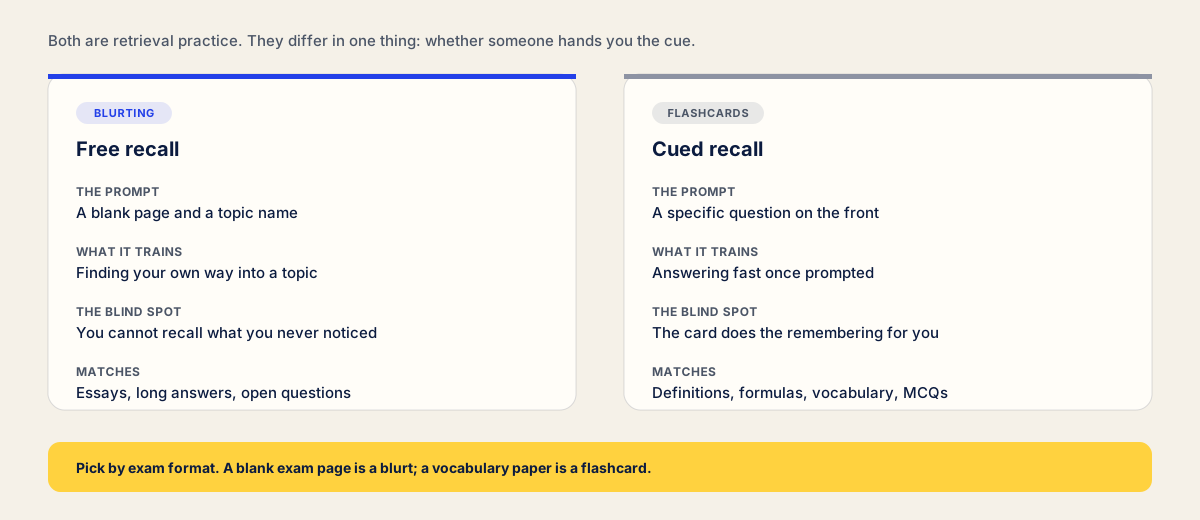
A flashcard that says define osmosis guarantees you will think about osmosis. That is its strength and its weakness at once: you are practising the answer but not the retrieval of the question. A blank page under the heading “cell transport” makes you supply both, which is harder and closer to what an essay paper demands.
So match the method to the paper. If your exam gives you a broad question and an empty booklet, blurt. If it tests discrete facts, formulas, vocabulary or multiple choice, flashcards with spaced repetition are more efficient, because they guarantee coverage of every item rather than the ones you happened to think of. Most students need both, and it is not a close call which comes first: blurt to find out what is missing, then build flashcards from the gaps.
What the blurting revision method cannot do
The blind spot is built into free recall. You can only write down what you retrieve, which means a blurt systematically over-samples what you already know and stays silent about material you never properly encoded in the first place. A topic you skipped in lectures will not show up as a gap. It will not show up at all.
This is exactly why the notes-check exists, and why blurting on its own is not a complete revision strategy. Three other limits worth knowing:
- It does not teach you anything new. Trying to blurt a topic you have not learned yet produces a blank page and a bad mood. You need to understand the information first, then test whether you are able to recall it.
- It is weak for skills rather than facts. Recalling the quadratic formula is not the same as using it under time pressure. For application, you want past paper questions.
- It rewards whatever you happen to notice. Two students can blurt the same chapter and produce entirely different pages, both feeling thorough.
Where the blurting method works best, by subject
Blurting works best where the exam wants structured knowledge out of your head with minimal prompting. The blurting method works best on content you could imagine being asked to explain rather than merely identify.
Biology, history, psychology, geography, law. Close to ideal. Content-heavy, organised into topics, assessed with written answers. Blurt the stages of mitosis, the causes of a war, a named study with its method and findings.
Chemistry and physics. Good for definitions, equations, mechanisms and derivation steps. Follow each blurt with a problem, because knowing the equation and deploying it are separate abilities.
Maths. The weakest fit. Blurt formulas and theorem conditions if you like, but the real work is solving unfamiliar problems, and no amount of blurting substitutes for that.
Languages. Useful for grammar rules and set phrases; less useful for vocabulary, where cued recall with spaced repetition is simply better suited to hundreds of discrete items.
Essay subjects. Strong, and underused: give yourself a past question and blurt the essay plan — argument, evidence, counterpoint — rather than the content. That rehearses the thing you are actually marked on.
How long should a blurting session take?
One cycle on one chunk of material takes roughly 10 to 20 minutes: a few minutes reading, five to ten writing, five checking. A full blurting session of three or four cycles runs 45 minutes to an hour.
The common error is scale. Trying to blurt an entire chapter in one go produces a shallow list of whatever surfaced first, because free recall output drops off sharply after the first burst. Blurt one sub-topic at a time — the thing that would be a single heading in your notes.
Do not try to blurt an entire chapter in one sitting for the same reason you would not sit a three-hour paper on it. Fitting several cycles into a full revision day is a scheduling problem of its own, and we lay out a workable shape for it in how to study for long hours. If you are producing almost nothing, that is information rather than failure: the material was never learned properly, so go back and learn it instead of grinding out blank pages.
How often should you blurt? The 2-3-5-7 revision schedule
Blurting tells you what to do in a session. Spaced repetition tells you when, and the two combine neatly.
The 2-3-5-7 method is the schedule most UK revision guides now recommend: learn a topic on day one, then revisit it on days 2, 3, 5 and 7. The widening gaps are deliberate, each review landing shortly before you would have forgotten. There is a backwards version too — counting 2, 3, 5 and 7 days back from the exam date to place your sessions — which suits revision that starts late.
Use a blurt as the review activity on each of those days and you get retrieval practice and spacing from one piece of paper. For a difficult topic, tighten the intervals; for one that is holding, stretch them. We go into the evidence for spacing in 7 secret methods for studying.
Should you blurt by hand or type it?
You will be told to handwrite, on the grounds that writing by hand improves long-term retention. That advice rests almost entirely on Mueller and Oppenheimer’s 2014 study of laptop versus longhand note-taking in lectures — and the finding has not held up. A direct replication by Morehead, Dunlosky and Rawson (2019) found no consistent difference between groups, including a group that took no notes at all. A second replication in 2021 reached the same conclusion, and its meta-analysis across eight studies put the longhand advantage at a negligible Hedges’ g of 0.04.
Two caveats worth stating plainly: that literature is about taking notes during a lecture, not about blurting, and no one has run the comparison on blurting specifically. But the evidence usually cited for “you must handwrite” does not support it.
Handwriting does have one practical edge for blurting practice — arrows, diagrams and spatial sprawl are easier on paper, and a whiteboard is better still because wiping it clean costs nothing. Use whichever you will actually do, because the technique works either way.
Common mistakes that make blurting feel useless
Blurting before you have learned the material. The page stays blank, you conclude the method is broken, and the method was never the problem.
Never marking the blurt. You keep the discomfort and throw away the benefit. See above.
Peeking mid-blurt. One glance converts the exercise back into copying.
Rereading the whole section during gap-filling. Re-study only what you missed. Otherwise you have just added a blurt to your rereading rather than replacing it.
Blurting the same topic twice in ten minutes. Your second attempt scores brilliantly and teaches you nothing. Space it.
Treating the first attempt as a verdict. Everyone’s first blurt is thin. The comparison that matters is the first against the third.
Only blurting what you enjoy. Free recall gravitates to comfortable material. Work from a topic checklist so the syllabus sets the goal, not your mood.
How to use blurting inside a study system, not as your whole study method
Blurting is a study method, not a study system. A system needs three things: a way to decide what to cover, a way to practise recalling it, and a way to check you were right. Blurting is the middle one.
- 1
Decide the scope
List the sub-topics from the curriculum or exam specification, not from your notes or your textbook. What is missing from your notes is precisely what you will not think to blurt.
- 2
Blurt, mark, re-blurt on a 2-3-5-7 rhythm
One sub-topic per cycle, marked in a different colour the same session, revisited on widening intervals.
- 3
Convert persistent gaps into flashcards
Anything you miss twice is not a blurting problem, it is an item that needs cued repetition until it sticks.
- 4
Finish with past paper questions under time
Recall gets you the content; timed practice gets you the marks. Blurting is not a substitute for sitting the paper.
Where AI summarizing fits — and where it does not
A word of caution first, because the temptation is obvious. Reading a summary produced by artificial intelligence is not blurting. It is rereading with fewer words, and the whole point of the research above is that rereading loses. No tool can retrieve on your behalf, and understanding is what you are after.
Where a summarizer genuinely helps is before the blurt, in the part of revision that is sorting rather than learning. If you are facing a 60-page PDF of lecture slides, you need a topic list before you can blurt anything, and building that list by hand is an evening you do not have.
- 1
Summarize to get the topic list
Upload the PDF and read the key points once. You are extracting the headings you will blurt against, not learning the content.
- 2
Close it and blurt each heading
Blank page, one sub-topic at a time. The summary stays shut. If it is open, you are not blurting.
- 3
Use the source, not the summary, to mark your gaps
Summaries drop qualifiers and occasionally invent tidiness. Mark against the original, especially for anything you will have to write in an exam.
In practice that means running the lecture deck or chapter through the PDF summarizer once, purely to harvest headings to blurt against. If your material is a whiteboard photo or a page of someone else’s handwritten notes — which is most of what circulates before an exam — the image summarizer will read it and give you the same topic list. Both are free and need no signup.
Marking is the step where this matters. Check your blurt against the original page, not against the summary, because the failure mode covered in our guide to summarizing a PDF is that summaries fail quietly — survivable when you are sorting, expensive when you are learning. If you want the full picture of which AI tools earn a place in revision, we tested them in best AI study tools.
Frequently asked questions
Is the blurting method effective?
Yes, and it is one of the better-evidenced study techniques available. Blurting is free recall, and in a 2011 Science experiment students who practised free recall scored 0.67 on a test one week later against 0.45 for students who built concept maps of the same text, with learning time matched. The advantage held even on questions requiring inference rather than memorisation.
How long should blurting take?
Around 10 to 20 minutes per cycle on a single sub-topic: a few minutes of reading, five to ten minutes of writing, then five minutes checking your notes and marking the gaps. Three or four cycles make a 45 to 60 minute blurting session. Do not try to blurt a whole chapter at once — free recall drops off sharply after the first burst.
What is the 2-3-5-7 method of revision?
It is a spaced repetition schedule: learn a topic on day one, then review it on days 2, 3, 5 and 7. The widening intervals are the point, since each review should land just before you would forget. A common variant works backwards from the exam date instead, placing sessions 2, 3, 5 and 7 days before the paper. Blurting is a good choice for the review activity on each of those days.
Is blurting better than flashcards?
They do different jobs. Blurting is uncued recall, which matches essays and long written answers where nothing prompts you. Flashcards are cued recall, which suits definitions, formulas and vocabulary, and they guarantee you cover every item rather than only the ones you happened to think of. Blurt first to find your gaps, then make flashcards out of them.
Why does blurting feel like it is not working?
Because it is designed to feel that way. Tested five minutes after studying, rereaders outperform blurters 83% to 71%. A week later the result reverses to 61% against 40%. Students also mispredict it badly: in the Karpicke and Blunt study, 101 of 120 learned more from retrieval practice but only 30 expected to. Discomfort and a low first score are not signs of failure.
What if I cannot remember anything when I blurt?
Then you have learned something useful for the price of ten minutes: the topic was never encoded properly. Go back and study it, then blurt again. An empty page on a topic you genuinely studied is different from an empty page on a topic you skimmed, and it is worth knowing which one you are looking at.
Should I blurt by hand or on a computer?
It probably does not matter much. The handwriting advice traces back to a 2014 laptop-versus-longhand note-taking study whose central finding failed two direct replications, with a meta-analysis putting the longhand advantage near zero. Paper and whiteboards do make diagrams and arrows easier, which is a real practical advantage for blurting. Use whichever you will actually do.
The short version
Blurting works, and it works for a reason older than the hashtag: retrieving information from memory builds a route back to it, and rereading does not. The evidence is strong enough that this active recall technique beat concept mapping in Science, on inference questions, with study time matched. As an effective study technique for preparing for exams, it is hard to beat on effort per pound spent, since the equipment is a pen.
The two things to take from the research rather than the trend: mark your gaps in the same session, because a failed retrieval only pays off when the answer follows it, and stop judging the method on how it feels. It is supposed to feel worse than rereading. That is the trade — you give up the comfortable illusion of knowing something today in exchange for still knowing it in June.