Most advice on how to study for a test is a list of habits — get enough sleep, find a quiet place, don’t cram. Useful, but it skips the question you actually have: I have a test on Friday. What do I do today, tomorrow and Thursday?
So this guide gives you plans. There is a study schedule for a week, for three days, for two days and for the night before, and specific advice for multiple-choice, essay, math and open-book tests. All of it rests on two study skills that decades of memory research agree on: testing yourself and spacing out your study sessions.
What is the best method to study for a test?
The best method to study for a test is to test yourself repeatedly, in short sessions spread over several days. In a major review of ten common study techniques, Dunlosky and colleagues rated only two as highly effective: practice testing and distributed (spaced) practice. Rereading, highlighting and summarizing were rated low — and they are exactly what most students do.
The reason is how memory works, and why so many students struggle to retain what they read. Every time you pull an answer out of memory, you strengthen the path back to it. Reading the answer again feels productive, but it does not build that path. In a classic experiment, students who reread a passage scored better after five minutes, but a week later the students who had tested themselves remembered 61% compared with 40%.
Step 1: Find out exactly what is on the test
Before you open a textbook, get the answers to these questions:
- What topics, chapters and lectures does it cover? Check the syllabus or ask your teacher.
- What types of questions will there be? Multiple choice, short answer, essay, problems?
- How long is it, and how is it scored? Knowing the allotted time lets you practice at the right pace.
- Are there past tests or sample questions? Nothing prepares you better for a specific test.
Familiarize yourself with the format early. Teachers usually tell you what matters: topics they repeated, wrote on the board or said would be on the test. Those go at the top of your list.
Step 2: Condense your study materials
Gather everything — notes, handouts, slides, textbook chapters, old quizzes — and condense it into a single page of topics. This page becomes your study plan.
The textbook and slides are usually the biggest pile. To get through them faster, run a long chapter or PDF through a free PDF summarizer and lecture slides through the PowerPoint summarizer to see the main points of each in a few minutes. Copy the topics onto your page, then go back to the source for anything you do not understand well. If you still need to take notes on a chapter, our guide on how to take notes from a textbook shows a faster method than copying.
Make sure you understand each topic before you move on. Then turn each topic into a question. “Photosynthesis” becomes “What are the inputs and outputs of photosynthesis, and where does each stage happen?” A list of questions is something you can practice; a list of topics is something you can only reread.
Studying from summaries is just faster rereading. Use them to decide what to study, then close them and answer your questions from memory.
Step 3: Make a study schedule and plan your study sessions
Work backwards from the test date. Put the hardest and most important topics first, and plan short study sessions of 25 to 50 minutes with breaks, rather than one long block. Here is a one-week study plan for a test on Friday:
| Day | What to do | Time |
|---|---|---|
| Friday (1 week before) | Condense materials, write questions for every topic | 60 min |
| Saturday | Answer all questions from memory, mark the ones you miss | 45 min |
| Monday | Re-study missed topics, then answer all questions again | 45 min |
| Wednesday | Full practice test, timed, no notes | 60 min |
| Thursday | Review only what you got wrong; light recall of everything | 30 min |
| Friday | Quick look at your one-page sheet over breakfast | 10 min |
Set aside the time in your calendar now. That is about four hours in total, spread across a week, and it will beat eight hours of rereading the night before.
Step 4: Test yourself with active recall and practice tests
Every study session after the first should start with retrieval, not reading. Ways to do it:
- Blank page recall. Write everything you remember about a topic, then check your notes and mark the gaps. This is the blurting method.
- Flash cards. Good for definitions, vocabulary, formulas and dates. Say the answer before you flip.
- Practice tests. Past papers, textbook review questions or questions you wrote. Do them timed and without notes to simulate the actual test.
- Mind map it. Draw a mind map of a topic from memory, then compare it with your notes.
- Teach it. Explain a concept out loud as if to a classmate. Where you stumble, you don’t understand it yet.
Getting answers wrong when you answer questions in practice is not a failure — it tells you exactly what to review, and retrieval after a mistake, followed by the correct answer, is one of the fastest ways to learn.
Step 5: Space your reviews — the 2-3-5-7 method
The 2-3-5-7 method is a simple spaced repetition schedule: study a topic on day one, then review it on days 2, 3, 5 and 7. The gaps widen because each review should land just before you would forget.
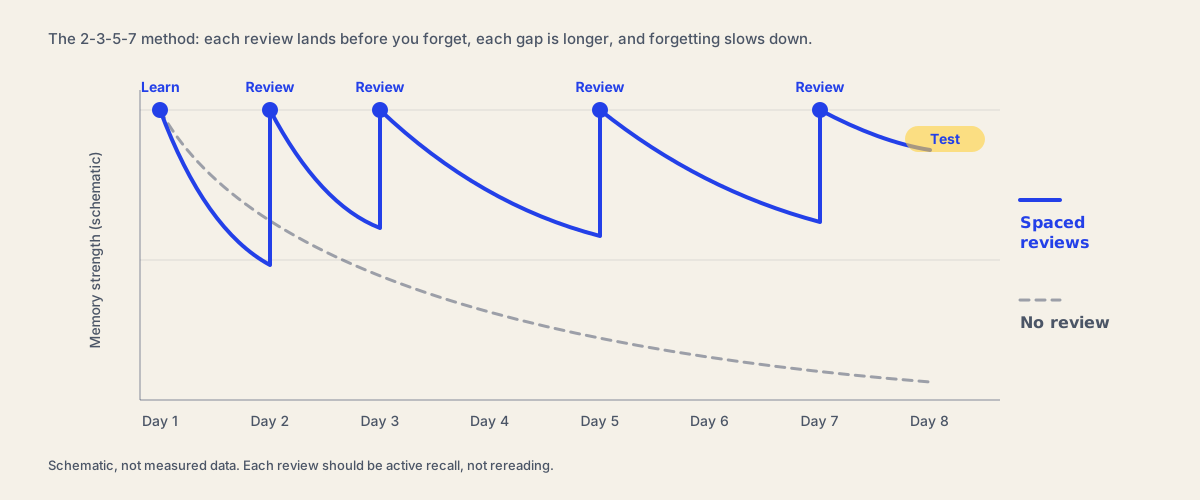
Research by Cepeda and colleagues found the best gap depends on how far away the test is. For a test a week away, reviewing after about a day worked best; for a test five weeks away, the best gap was more than a week. The practical rule: the further away the test, the longer the gaps between reviews, and the final review should be a day or two before the test.
Test prep plans by how much time you have
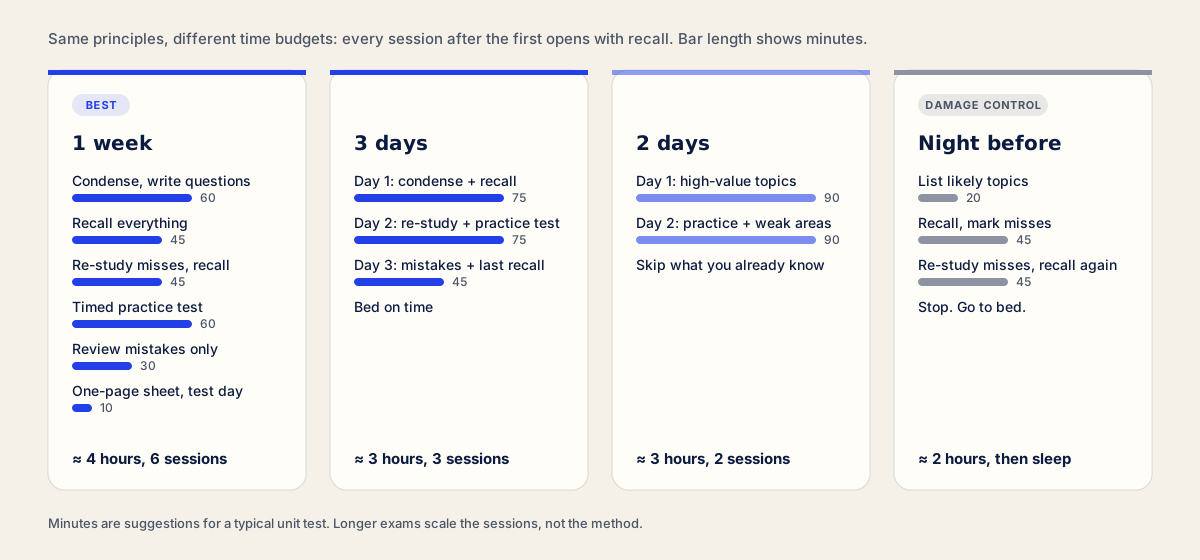
If you have one week
Use the schedule above. Five sessions, each starting with recall, one full practice test midweek, and a light review the day before.
If you have three days
- Day 1: Condense materials and write questions (45 min). Answer them all from memory (30 min).
- Day 2: Re-study what you missed, then do a practice test (60–75 min).
- Day 3: Review only your mistakes, then do one last round of recall (30–45 min). Go to bed on time.
Is 2 days enough to study for an exam?
Two days is enough for a single test on material you have followed in class, if you are efficient. It is not enough to learn a whole unit from scratch. Prioritize: spend day one on the topics most likely to appear and worth the most points, and day two on practice questions and your weakest areas. Skip anything you already know well.
The night before: read over your notes, then go to bed
If you are starting at the last minute, accept that you cannot cover everything and focus on what is most likely to be tested:
- Make your one-page list of topics (20 minutes).
- Test yourself on each one and mark what you miss (45 minutes).
- Study only what you missed, then test yourself again (45 minutes).
- Stop and go to bed. Sleep is when memory consolidates; an all-nighter trades tomorrow’s recall for tonight’s reading.
Cramming does work for tomorrow, but the material fades quickly afterwards — a problem if there is a final exam later.
The morning of the test
Eat breakfast, look over your one-page sheet for ten minutes, and do a few easy practice questions to warm up. Don’t try to learn anything new.
How to prepare for different types of tests
Multiple-choice tests
Multiple-choice questions test recognition, but studying by recognition — rereading — is a trap, because every option will look familiar. Practice recall first, then do sample multiple-choice questions. On the test, try to answer each question before reading the options, eliminate clearly wrong answers, and watch for words like “not”, “always” and “except” when reading a question.
Essay tests
Predict the likely questions from the topics your teacher emphasized. For each one, outline an answer: a thesis, three main points and the evidence for each. Then practice writing one or two full answers under a time limit. On the test, spend the first few minutes outlining before you write.
Math and science problem-solving tests
Do problems, not reading. Work through practice problems without looking at the worked solutions first, and mix different problem types together so you learn to recognize which method each question needs. In one classroom study of seventh graders, students who practiced mixed problems scored 61% on a test a month later, compared with 38% for students who practiced one type at a time. Rewrite every formula you need on a practice sheet from memory until you can do it without errors.
Standardized tests like the SAT
Exams like the SAT, the PSAT and the ACT are standardized, so the types of questions barely change from year to year. That makes official practice tests the best SAT prep there is: take full ones under timed conditions, review every mistake, and learn the format so you need less time to read the instructions on test day. Students with approved accommodations may get extra time, so check what applies to you well in advance.
Open-book tests
Open-book tests are usually harder, not easier, because they test understanding and application. Take notes you can navigate: organize them with clear headings and tabs so you can find information quickly, and study as if the book were closed. If you have to look up every answer, you will run out of time.
Test-taking tips for test day: how to take the test calmly
- Get enough sleep and plenty of rest the night before — 8 hours if you can. It matters more than an extra hour of studying.
- Eat a normal breakfast and bring water.
- Arrive early with everything you need, so you are not rushing.
- Write your worries down. In a study by Ramirez and Beilock, students who spent ten minutes writing about their test anxiety just before an exam performed better than those who did not.
- Skim the whole test first, answer the questions you know, then return to the harder ones.
- Check the clock at the halfway point so you have time for every section.
Study habits that waste time: cramming, distraction and rereading
- Rereading notes over and over. It feels like studying but builds little memory.
- Highlighting or underlining whole pages. If everything is highlighted, nothing is important information.
- Studying only what you already know, because it feels good. Spend most of your time on your weakest topics.
- One long session instead of several short ones.
- Studying with your phone in reach. Every notification restarts your focus.
- Pulling an all-nighter. You lose the sleep that would have locked in what you studied and hurt retaining the information you need to remember.
- Studying alone when you are stuck. Ask your teacher or a tutor before the test, not after.
For longer revision days, such as before finals, our guide on how to study for long hours covers breaks and energy, and our 7 evidence-based study methods go deeper into each technique.
Frequently asked questions
How many hours should I study for a test?
For a typical unit test, three to five hours spread over a week is usually enough if you test yourself rather than reread. Bigger exams and finals need more. The number of sessions matters more than the total: five 45-minute sessions beat one four-hour session.
What is the 2-3-5-7 study method?
It is a spaced repetition schedule. You learn a topic on day one, then review it on days 2, 3, 5 and 7, testing yourself each time instead of rereading. The widening gaps strengthen memory, because each review happens just before you would start to forget.
Should you study the night before a test?
A short review the night before is helpful: go over your mistakes and test yourself on key topics for 30 to 60 minutes. Avoid learning large amounts of new material or staying up late, because sleep is when your brain consolidates what you studied.
How do I remember everything I studied?
The best way to remember information is to test yourself instead of rereading, spread your reviews over several days, and sleep well before the test. Turning your notes into questions, explaining concepts out loud and using flash cards for facts and formulas all make information easier to retrieve under pressure.
The short version
Preparing for tests does not need to take over your week. To study for a test: find out what it covers, condense your materials to one page of questions, and answer those questions from memory in short sessions spread across several days. Take at least one timed practice test, spend most of your time on what you get wrong, and sleep the night before. That is less time than most students spend studying — and it works better.