Most students take notes from a textbook the same way: read a paragraph, copy the important-looking sentences, repeat until the end of the chapter. Three hours later there are ten pages of notes, and a week later very little of it is in their heads.
The problem is not effort. It is that copying lets you move text from the book to your notebook without it passing through your memory. This guide shows you how to take notes from a textbook in a way that is faster and makes you think: preview the chapter, read one section at a time, close the book, and write what you remember. Your notes end up shorter, in your own words, and ready to study from.
Why copying while reading textbooks doesn’t work
In 2013, a team of psychologists led by John Dunlosky reviewed the evidence on ten popular study techniques. Highlighting and rereading — the backbone of most textbook reading — were rated as low utility: they help little, if at all. Practice testing, which means pulling information out of memory, was rated highly effective.
Copying sentences from a textbook is close to rereading with a pen in your hand. It is passive reading, not active reading. It keeps you busy, but you never have to remember or explain anything. That is why many students make the mistake of measuring notes by length. Good notes from a textbook are not the longest ones. They are the ones you had to think to write.
A 2011 experiment by Jeffrey Karpicke and Janell Blunt shows the difference. Students who read a science text and then practiced recalling it from memory remembered more a week later than students who built detailed concept maps with the text open — even on a test that asked them to draw a concept map.
Before reading: preview the chapter
Before you start reading, take a few moments — about five minutes — to get an overview of the entire chapter. You are building a map, so that when you read the details you know where they fit.
- Read the chapter title, the introduction and the summary at the end of the chapter.
- Skim the headings and subheadings. They are the author’s outline of the chapter.
- Note the key terms in bold or in the margin, and look at every diagram, graph and table.
- Read the end-of-chapter questions. They tell you what the author thinks matters most.
For a long chapter or a textbook PDF, a free AI PDF summarizer like PDFSummarizer.net gives you the main points of a chapter in under a minute. If you only have a printed book, take photos of the pages and run them through an image summarizer. For a whole book, a book summarizer can outline every chapter. Use the overview to decide what to focus on — not as a replacement for reading.
A summary written by someone else, or by AI, has not passed through your memory. Use it to preview and to check your notes, then write your own.
How to take notes from a textbook in 6 steps
This is the core method. It works for any subject and any textbook.
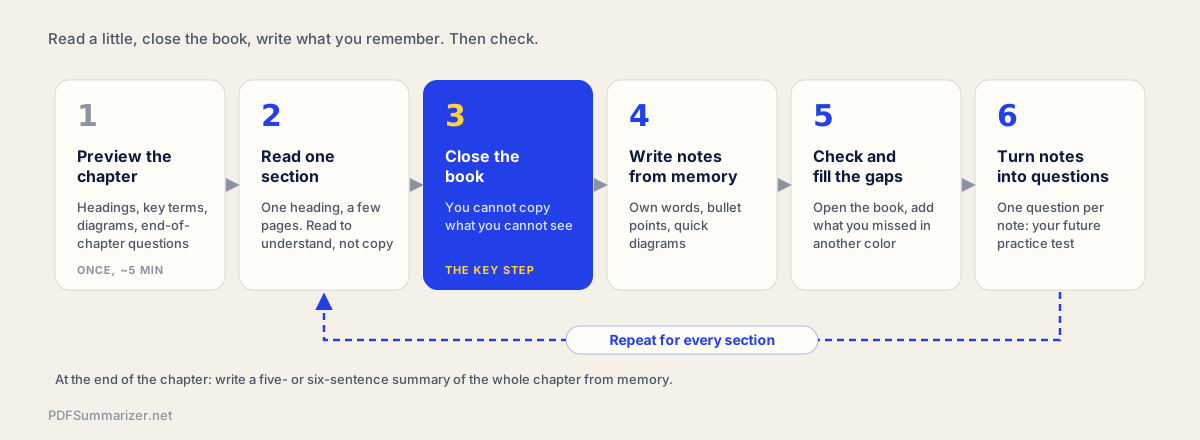
- 1
Preview the chapter
Spend five minutes on the title, headings, key terms, diagrams and the end-of-chapter questions, as described above. Write the headings on a sheet of paper as the skeleton of your notes.
- 2
Read one section without taking notes
Read a single section — usually the text under one heading, a few pages at most. Read to understand, not to copy. If a paragraph is confusing, reread it now.
- 3
Close the book
This is the step that makes the method work. With the book closed, you cannot copy, so you have to remember.
- 4
Write notes from memory
Jot down the main ideas of the section in your own words: key terms, how things connect, a quick diagram if it helps. Use bullet points, not full sentences.
- 5
Check against the text and fill the gaps
Open the book and compare. Add what you missed in a different color, and fix anything you got wrong. The gaps show you exactly what you did not understand.
- 6
Turn your notes into questions
Next to each note, write a question it answers. 'Light reactions happen in the thylakoid' becomes 'Where do the light reactions happen?' These questions are your study material.
Then move to the next section and repeat steps 2 to 6. At the end of the chapter, write a summary of the whole chapter in five or six sentences, from memory.
If you own the book, light annotation in the margin while reading is fine: a question mark where you are confused, a star next to a key idea. A highlighter used on every line is not.
The first few times this will feel slower than copying, because it is harder. That difficulty is the point: the effort of remembering is what makes you retain the material. Within a week or two, most students find they get through a chapter in about the same reading time as before — with far better notes.
What good notes from a textbook look like
Here is how one section of a biology chapter on photosynthesis might look after the six steps. The notes were written from memory, and the additions after checking are marked.
| Question | Notes |
|---|---|
| What goes in and out of photosynthesis? | In: CO₂, water, light. Out: glucose, O₂ |
| What are the two stages? | Light reactions → make ATP and NADPH. Calvin cycle → uses them to fix CO₂ into sugar |
| Where does each happen? | Light reactions: thylakoid membrane. Calvin cycle: stroma (added after checking) |
| Why does the Calvin cycle need light? | Indirectly — needs ATP/NADPH from light reactions (added) |
That is the whole section in four lines, with a question for each. Compare that with a page of copied sentences, and it is easy to see which one you would rather study from the night before an exam.
Note-taking methods for textbooks
There is no single right way to take notes. Different methods work better for different subjects:
| Method | How it works | Best for |
|---|---|---|
| Cornell notes | Page split into notes, a question column and a summary at the bottom | Most subjects; built-in self-testing |
| Outline | Headings and indented bullet points that follow the textbook’s structure | History, law, social sciences |
| Mind map | Main topic in the center, branches for subtopics | Seeing connections, visual learners |
| Charting | A table comparing items across the same categories | Comparing theories, periods, organisms |
Cornell notes
The Cornell method was developed by Walter Pauk at Cornell University in the 1950s, and it fits the six steps well. Divide the page into a wide right column for notes, a narrow left column for questions and a strip at the bottom for a summary. Write notes on the right, questions on the left, and the summary at the bottom once you have finished reading. To review, cover the right side and answer the questions.
Outline
Use the textbook’s headings and subheadings as the structure and indent the main points under each. Outlines are fast and make the structure of the chapter clear, but they tempt you to copy. Write them with the book closed.
Mind map and charting
A mind map works when the relationships between ideas matter more than the order. Charting works when the chapter compares things — a table with rows for each theory and columns for key thinker, main idea and criticism condenses a chapter into one page.
How to write notes in your own words
When you make notes in your own words, you have to understand the material first. Writing notes in your own words is what separates notes that help you learn from notes that don’t. A few ways to make it easier:
- Explain it to a friend. Write the note as if you were explaining it to someone who has not read the chapter.
- Use abbreviations and symbols. Arrows for causes, = for definitions. Your notes are for you.
- Keep only one quote per section, at most. Copy exact definitions of key terms if you must, with a page number, but restate everything else.
- Draw it. A quick diagram of a process is often clearer and faster than a paragraph.
If you are taking notes for an essay or research paper, add the page number to every note. It saves you from searching the entire textbook later and protects you from accidental plagiarism.
Should you take notes on paper or digitally?
A well-known 2014 study by Pam Mueller and Daniel Oppenheimer found that students who took lecture notes on laptops wrote more word-for-word and did worse on conceptual questions than students writing by hand. It was widely reported as proof that handwriting is better.
The picture is less clear than that. A 2019 replication by Kayla Morehead, John Dunlosky and Katherine Rawson found no reliable difference between the two, and a second replication in 2021 reached the same conclusion. What seems to matter is not the device but whether you copy or process. That is good news for textbook notes, because the six steps force you to process whatever you write with.
Both work, so choose what you will use:
- Paper is fast for diagrams and distraction-free. A pen or pencil and a notebook, or index cards for questions.
- Digital apps such as Microsoft OneNote, Notion or Evernote are searchable and easy to reorganize. Taking notes digitally also makes it easy to keep your notes next to a PDF of the textbook.
How long should it take to take notes from a textbook?
Reading textbooks with this method takes longer at first. Plan for roughly two to three times your normal reading time for the first chapters, falling closer to one and a half as the method becomes familiar. A 20-page chapter that takes 60 minutes to read might take 90 to 120 minutes with notes.
Split long chapters into reading sessions of 25 to 50 minutes with short breaks; for courses that require a lot of reading, that also keeps procrastination in check. If that seems like a lot, compare it with the alternative: reading a chapter, copying for two hours, and rereading those notes three times before the exam. Taking notes this way replaces most of the rereading. For tips on getting through the reading itself faster, see our guide on how to read faster.
Turn your notes and summary into study material
Notes are not the goal. They are the raw material for studying. Once a chapter is done:
- Test yourself with the questions. Cover the answers and go down the list. Mark the ones you miss.
- Try blurting. Write everything you remember about a topic on a blank page, then check your notes. Our guide to the blurting method explains how.
- Condense your notes. Before an exam, condense each chapter onto one page of questions, then space out your reviews. Our guide on how to study for a test has day-by-day plans.
- Make flashcards for key terms and definitions, on index cards or in an app.
Combined with good class notes and regular review, this is one of the habits that separate students with good grades from those who work just as hard — see how to get good grades in school for the rest.
7 rules to take good notes from a textbook
- Preview the chapter before you read and take notes.
- Read a whole section before you write anything.
- Write notes from memory, with the book closed.
- Use your own words, bullet points and diagrams — not full sentences.
- Check your notes against the text and fill the gaps in a different color.
- Write a question for every note, and a summary at the end of the chapter.
- Review the notes by answering the questions, not by rereading.
Common mistakes when taking notes while reading
- Taking notes while reading, sentence by sentence. You end up copying. Read first, then write.
- Highlighting everything. If you highlight as you read, limit it to one phrase per paragraph and only on a second read, when you know what matters.
- Notes that are too long. Pages of notes are a sign of copying. Aim for about one page per chapter section, or less.
- Skipping diagrams. Many exam questions come from figures and tables. Redraw the important ones from memory.
- Never looking at the notes again. Notes you do not review are a transcript, not a study tool.
- Never going back to the text. Checking your notes against the reading is where you catch mistakes. Skip it, and errors become part of what you study.
Frequently asked questions
How do you turn textbooks into notes?
Preview the chapter, then read one section at a time. After each section, close the book and write the main points from memory in your own words, check them against the text, and write a question for each note. At the end of the chapter, write a short summary from memory.
How do most college students take notes?
Most college students highlight the textbook and copy key sentences into their notes, and many take notes on a laptop. Research suggests these habits are less effective than writing notes from memory and testing yourself with them, whatever device you use.
Should I take notes from the textbook or the lecture?
Both, but differently. Lecture notes show what your professor thinks matters and is likely to be on the exam. Textbook notes fill in the details and explanations. Many students read the textbook chapter before class, keep short notes, and add to them from the lecture.
How can I take notes from a textbook quickly?
Preview the chapter so you know what to focus on, skip what is not relevant to your course, write short bullet points instead of sentences, and write from memory after each section rather than copying as you go. Copying feels thorough but takes much longer.
The short version
To take notes from a textbook effectively, preview the chapter, read one section at a time, close the book and write what you remember, then check and fill the gaps. Turn every note into a question and review by answering them. Your notes will be shorter, you will understand the material better, and you will have a practice test ready long before the exam.