Almost everyone who wants to read faster has seen the promise: triple your reading speed in a weekend, read a book a day, stop “hearing” the words in your head. The problem is that the research on reading does not support those claims. Speed reading courses mostly teach you to skim, and skimming is useful — but it is not reading faster with the same understanding.
The good news is that if you want to read faster — to study faster, or just to finish more books — you can still get through books, papers and reports much faster. Most of the time you save comes not from moving your eyes faster, but from deciding what to read closely, what to skim and what to skip. This guide covers what a normal reading speed is, what speed reading techniques actually do, and nine ways to read faster without losing comprehension.
What is a normal reading speed?
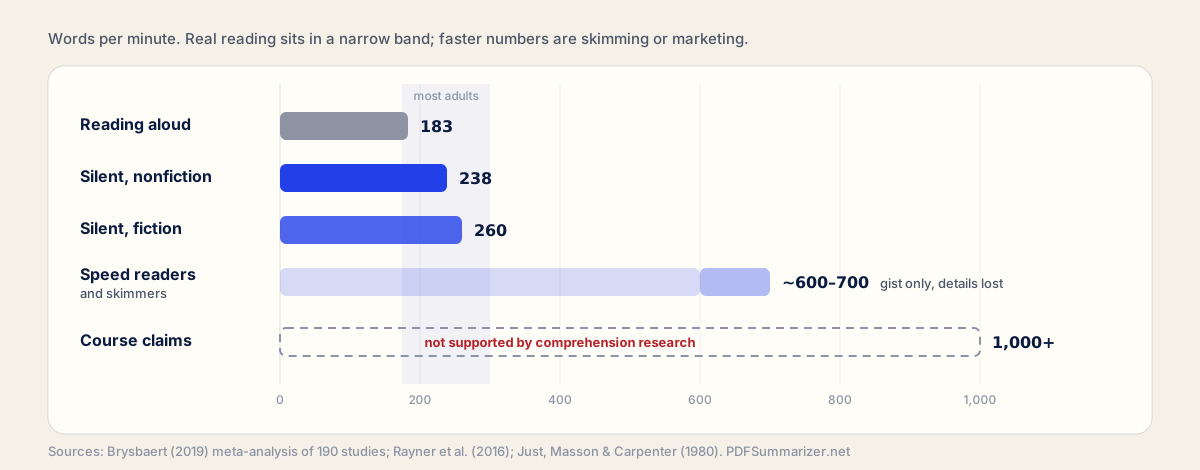
The most thorough answer comes from a 2019 meta-analysis by psychologist Marc Brysbaert, who combined 190 studies with more than 18,000 participants. For adults reading silently in English, the average reading speed was 238 words per minute for nonfiction and 260 for fiction. Reading aloud averaged 183 words per minute. Most adults fall somewhere between 175 and 300.
Words per minute are hard to picture, so here is what that means in pages per hour, assuming a typical paperback page of about 250 words:
| Reading speed | Pages per hour | What it feels like |
|---|---|---|
| 150 wpm | 36 | Dense textbook, careful study |
| 238 wpm | 57 | Average nonfiction reader |
| 300 wpm | 72 | Fast, skilled reader |
| 400+ wpm | 96+ | Skimming — you get the gist, miss details |
Textbook pages usually hold more words and harder ideas, so expect far fewer pages per hour there, and that is normal. Speed also varies by text: the same person may read a thriller at 300 words per minute and a contract at 120.
Does speed reading work?
Not in the way it is sold. In 2016, a team of cognitive psychologists led by Keith Rayner published a review of decades of reading research in Psychological Science in the Public Interest. Their conclusion: there is a trade-off between speed and comprehension, and no technique lets you read much faster than normal while understanding just as much.
The reason is how reading works. When you read, your eyes do not glide across the line. They jump in short movements, then pause on a word for about a quarter of a second. Each pause is called a fixation, and the jumps between them are saccades. During a fixation you can identify only a few letters to the left and about 14–15 characters to the right. Your peripheral vision cannot pick up words from the next line or the far side of the page, whatever a speed reading course may promise.
More importantly, most of the time in each fixation is spent understanding the word, not seeing it. Reading is a language skill more than a feat of visual perception. That is why the research points to language processing, not eye movements, as the bottleneck: the eye movements themselves take up no more than about 10% of reading time. You cannot train your eyes to comprehend faster.
When researchers have tested trained speed readers, the results are consistent. In the most complete study, by Just, Masson and Carpenter, speed readers covering around 600–700 words per minute did a little better than people told to skim on questions about the gist, but not as well as normal readers at about 250. On questions about details, speed readers and skimmers did equally poorly. Speed readers are skilled skimmers. That is a real skill, and a useful one — but it is a different thing from reading.
What about speed reading apps?
Apps that flash one word at a time in the same spot — a method called rapid serial visual presentation — remove eye movements entirely. They feel fast, but comprehension drops as the speed rises, partly because you cannot glance back at a word you missed. Rereading is not always a bad habit: in one experiment, when readers were prevented from looking back at earlier words, their comprehension fell.
Should you stop subvocalization and the words in your head?
Subvocalization is the inner voice that “says” the words in your head as you read. Many speed reading tips tell you to eliminate it, some by pressing your tongue to the roof of your mouth or humming while you read.
The research suggests this is a mistake. Inner speech seems to help you hold words in memory while your brain works out the meaning of a sentence. Studies that block it find that understanding of difficult text gets worse. Skilled readers do not stop subvocalizing — their inner voice simply becomes faster and less complete, especially for familiar words.
So there is no need to fight the words in your head. If your inner voice feels slow, it is usually because the text is hard or the vocabulary unfamiliar, and the fix is below.
How to read faster: 9 ways to increase your reading speed
These reading tips will not triple your speed. What they do is increase your reading speed where it is safe to, and save time in the process of reading as a whole.
1. Preview before you read
Before you start reading a chapter, spend two minutes on its structure: the table of contents, the headings, the introduction and conclusion, and the first and last sentences of each section. You will read the full text faster and understand more, because you already know where the argument is going.
2. Decide why you are reading
Set a reading goal before you begin. Are you looking for one fact, trying to understand an argument, or studying for an exam? Each needs a different pace. Reading every word of a report when you need one number is the slowest way to read.
3. Skim what you don’t need, read closely what you do
Skimming — reading headings, first sentences and anything highlighted — is the one speed reading technique that genuinely saves time. Use it deliberately: skim a whole section, decide whether it matters for your goal, then either read it properly or move on. Research on skimming under time pressure finds that readers who skim strategically can pick out the important parts of a text well.
4. Build vocabulary and background knowledge
This is the slowest method and the most effective. Familiar words are processed faster, new words slow you down, and a topic you already know needs less effort to understand. Every concept you already have is one you do not need to build while reading. That is why the best way to become a faster reader, according to the Rayner review, is to read more. A reading habit of 20–30 minutes a day compounds: each book makes the next one on the topic faster.
5. Use a pointer
Running a finger or pen under the line — sometimes called a tracer — is an old reading practice that Tim Ferriss popularized in a widely shared post on reading faster. It will not let you read three times faster, but a pointer can guide your reading along the line, so you skip fewer lines and keep a steady rhythm and pace of reading. It costs nothing to try for a week.
6. Cut the rereading caused by drifting attention
Some looking back is part of normal reading. What wastes time is reaching the end of a page and realizing you took in nothing. When your attention drifts, stop, ask yourself what the last paragraph said, and only then continue. Shorter sessions with breaks help more than forcing yourself through.
7. Remove distractions
Reading while notifications arrive is slower than you think, because every interruption costs you the time it takes to find your place and rebuild the context. Put your phone in another room and read in blocks of 25–45 minutes.
8. Practice in timed sprints
Set a timer for five minutes and read slightly faster than comfortable, then write down the main point of what you read. If you can still state it, keep the pace. If not, slow down. Treat it like any other exercise: this kind of practice reading nudges your pace up without letting comprehension quietly collapse. Pushing too fast will reduce comprehension, and the point is to improve your reading speed, not just move your eyes.
9. Switch to audio when it fits
For narrative nonfiction and podcasts, listening at a slightly faster speed can be a practical way to cover more material. Research on lecture videos suggests that moderate speed-ups have little cost for most learners, but very fast playback does. Keep dense or technical material in print, where you can slow down and look back.
Read books faster: start with the summary
The most effective way to read faster is to know what matters before you start. A summary gives you that: the main argument, the structure and the key points, so you can read the entire book or paper with a map instead of discovering the structure as you go.
For long PDFs, reports and articles, a free AI PDF summarizer like PDFSummarizer.net gives you that overview in under a minute. For books, a book summarizer outlines the chapters. Then use the summary to decide:
- which chapters need a close reading,
- which you can skim, and
- which you can skip entirely for your purpose.
Our guide on how to summarize a PDF covers how to check a summary against the source, so you know what you can rely on.
If you need to understand and remember the material — for an exam, a decision, a discussion — read the parts that matter. The summary tells you which parts those are.
When to skim and when to read slowly
Skilled readers are not fast at everything. They adjust. A useful way to think about it:
| Kind of reading | Speed | How to read it |
|---|---|---|
| Email, news, social posts | Fast | Skim, read closely only what needs action |
| Novels and narrative nonfiction | Comfortable | Read every word, enjoy it |
| Reports and articles for work | Mixed | Preview, then read the relevant sections |
| Textbooks and research papers | Slow | Preview, read in sections, take notes |
| Contracts, instructions, exams | Slowest | Read every word, sometimes twice |
Reading slower is the right choice for the bottom two rows. For textbooks, how you take notes affects how much you remember more than how fast you read — our guide on how to take notes from a textbook covers a method that is faster than copying and helps you retain much more.
How to read faster and retain more
Speed is only useful if you remember and understand what you read. Whether you are in med school or reading for fun, reading for comprehension beats reading for speed. Three habits improve comprehension and retention at the same time:
- Ask questions before you read. Turn headings into questions and read to answer them. It gives your reading a purpose and makes the answers stick.
- Recall after each section. Close the book and summarize the section in a sentence or two from memory. This takes a minute and is one of the most reliable ways to retain information.
- Review, don’t reread. A day later, try to recall the main points before looking at your notes. Our guide on how to study for long hours explains how to plan sessions like these without burning out.
You will not remember everything, and you do not need to. Retention and comprehension depend on connecting what you read to what you already know, which is also what makes the next book on the topic faster to read.
Reading faster with ADHD
If you have ADHD, the problem is often not reading speed or reading comprehension but attention: losing your place, rereading the same line or finishing a page with no idea what it said. Speed reading drills do not address that. Some strategies that many readers with ADHD find helpful:
- short reading sessions with a clear goal and a timer,
- a pointer or a ruler under the line to keep your place,
- reading along with an audiobook or text-to-speech, and
- previewing a summary first, so you know what to look for.
ADHD and reading difficulties such as dyslexia often occur together. If reading is persistently hard, it is worth talking to a doctor or learning specialist rather than trying to fix it with technique alone.
How to measure your reading speed without an app
To find your current reading speed, pick a book at your normal level and read for five minutes at a comfortable pace. Count the words on three full lines, divide by three to get words per line, multiply by the number of lines you read, and divide by five. Then write down the main point of what you read to check your comprehension.
Retest every few weeks on similar material. A steady increase in reading speed with the same level of understanding is real progress. A jump in speed with a vague sense of what you read is skimming.
Frequently asked questions
What is the fastest technique to read faster?
Previewing and skimming. Reading the table of contents, headings and the first and last sentences of each section, or a summary of the whole text, lets you decide what to read closely and what to skip. That saves far more time than trying to move your eyes faster.
Can you read 100 pages in an hour?
Only by skimming. At 250 words per page, 100 pages an hour is about 417 words per minute — well above the adult average of 238–260. You can cover 100 pages in an hour to get the gist of a light book, but you will miss details and much of the reasoning.
Is 20 pages an hour slow?
It depends on the text. For a novel, 20 pages an hour is slow. For a dense textbook or research paper, where pages hold more words and you are taking notes, 20 pages an hour is a normal and sensible pace.
How can I read faster and understand more?
Build vocabulary and background knowledge by reading regularly, preview each text before reading it, and recall the main points after each section. These improve speed and comprehension together, while speed reading techniques trade one for the other.
The short version
Most adults read 200–300 words per minute, and no technique will let you read several times faster with the same comprehension. What you can do is spend your reading time better: preview, set a goal, skim what does not matter and read closely what does. Read more to build vocabulary, and recall what you read so it stays. That is how to read faster — and actually remember the books you finish.