Ask how to get good grades in school and you will get a hundred tips: sit at the front, use colored pens, drink water, study with music, study without music. Some of these help, most make no measurable difference, and none of them tell you where your grades are actually going wrong.
If you want to improve your grades, this guide does the opposite. It starts with a five-minute grade audit to find out where you lose points, then gives you the habits with the strongest evidence behind them, in the order they matter. It works for middle school, high school and college, and there is a section at the end for parents.
The 5 things that matter most
If you only change five things, change these:
- Go to every class and do the work that is graded most heavily.
- Review your notes the same day, for ten minutes, by testing yourself.
- Start studying for tests a week early, in short sessions, not one long one.
- Keep one planner with every due date, and check it daily.
- Ask your teacher what an A answer looks like — before the assignment, not after.
Everything below explains how to do each of these well.
Start with a grade audit
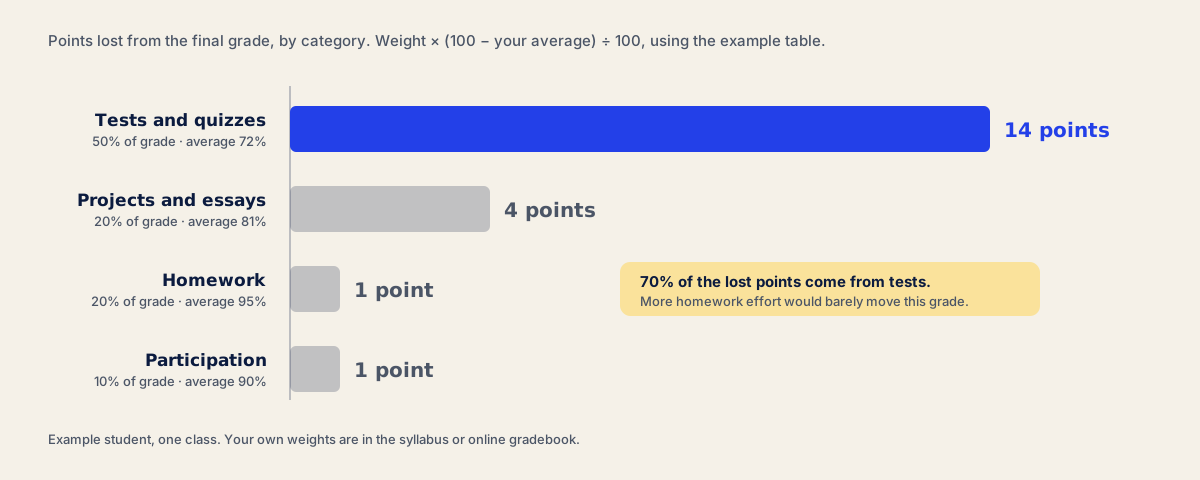
Most students trying to improve their grades work harder at everything. It is faster to find the one category that is costing you. Open your online gradebook or collect your graded work and fill in a table like this for each class:
| Category | Weight of final grade | Your average | Points you are losing |
|---|---|---|---|
| Tests and quizzes | 50% | 72% | 14 |
| Homework | 20% | 95% | 1 |
| Projects and essays | 20% | 81% | 4 |
| Participation | 10% | 90% | 1 |
The last column is weight × (100 − your average) ÷ 100. In this example, nearly all the lost points come from tests. More effort on homework would change almost nothing; better test preparation would change the letter grade.
Different results point to different fixes:
- Losing points on tests: you probably do not know how to study effectively yet, and your study techniques need to change (see habits 5 to 8).
- Losing points on homework: it is usually missing work, not bad work — a time management issue.
- Losing points on essays and projects: you need clearer expectations and feedback from the teacher before you hand work in.
In class: show up, engage and take better notes
1. Go to every class
It sounds too obvious to list, but the evidence is striking. A meta-analysis by Credé, Roch and Kieszczynka found that class attendance was a better predictor of college grades than admission test scores, high school GPA or study habits. Missing a class means missing the teacher’s emphasis — which is often a preview of the test.
2. Sit where you cannot hide, and ask questions
You do not have to sit in the front row, but sit where the teacher can see you and you can see the board. When you don’t understand something, ask. If asking in class is hard, write the question in the margin of your notes and ask after class or by email the same day.
3. Take notes you will actually use
Good note-taking is a skill. Good notes are short, organized and written in your own words. One reliable format is the Cornell method: divide the page into a narrow left column and a wide right column. Take notes on the right during class; afterwards, write a question for each main idea on the left. You now have a built-in quiz. Write down anything the teacher repeats, writes on the board or says “this is important” about.
After class: the 10-minute review
4. Review the same day — by testing yourself
The most effective thing you can do with your notes is not to reread them. Cover them, and try to write down everything you remember from the lesson on a blank page. Then check what you missed. This is called the blurting method, and it takes about ten minutes.
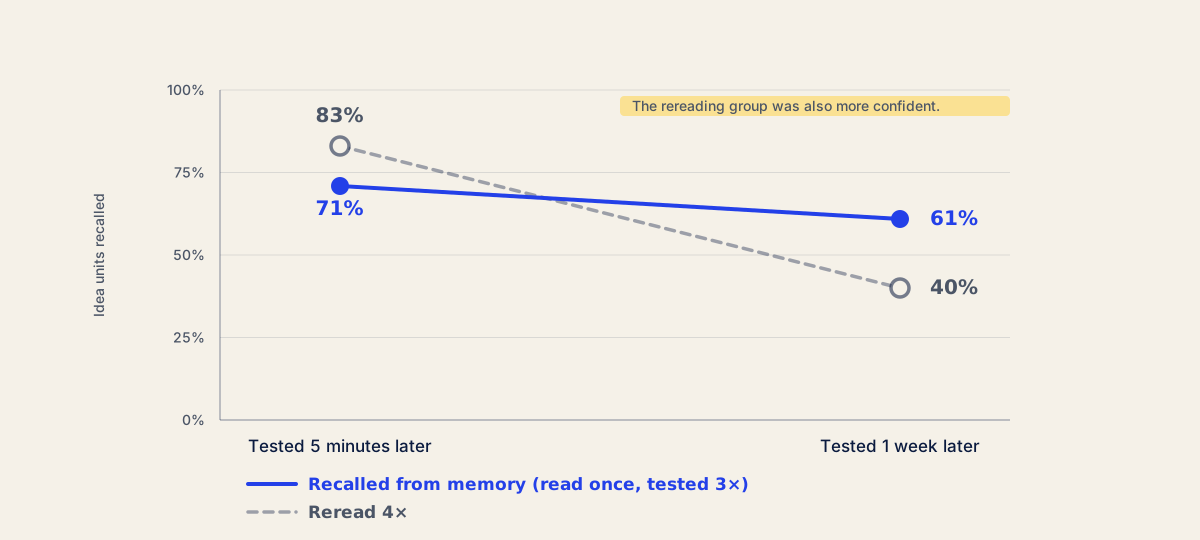
Why it works: retrieving information from memory strengthens it far more than reading it again. In a well-known experiment by Roediger and Karpicke, students who reread a passage did slightly better five minutes later, but one week later the students who had practiced recalling it remembered 61% against 40% for the rereaders.
Learn how to study: smarter, not longer
5. Use active recall instead of rereading and highlighting
A large review of study techniques by Dunlosky and colleagues rated rereading and highlighting as low utility — the two techniques students use most. Practice testing and spacing were the only two rated high utility. Replace rereading with anything that makes you produce the answer: flash cards or notecards, practice problems, explaining a concept out loud, or answering the questions from your Cornell notes.
6. Space your studying over several days
Three 30-minute sessions on Monday, Wednesday and Friday beat one 90-minute session on Thursday night, even though they feel less productive. Each gap lets you forget a little, and relearning after a gap builds stronger memory. For a full plan, see our 7 study methods backed by evidence.
7. Mix up practice problems
In math and science, do problems of different types in one session instead of twenty of the same kind. It is harder, but it trains you to recognize which method a question needs — exactly what a test asks you to do.
8. Turn long readings into study notes
Long textbook chapters and handouts are where many students lose hours: reading them twice, then highlighting half the page. A better order is to get the structure first, ideally a chapter ahead of the class. Run the chapter or PDF through a free PDF summarizer to see the main points in a few minutes, then read the chapter with a purpose, then close it and quiz yourself on those points. Our guide on how to take notes from a textbook walks through this section by section.
Use the summary as a map, not as a replacement. If you study from summaries instead of recalling the material, you are back to rereading — just a shorter version of it.
Skim the summary to see what matters. Read the chapter and write five questions it answers. Next day, answer them without looking. The questions you miss are your study list.
Homework and time management
9. Keep one planner, and check it every day
Homework has a positive link with achievement, especially in middle and high school, according to a synthesis of homework research by Cooper, Robinson and Patall. But most homework points are lost to missing or late work, not wrong answers. Good time management skills start here: keep track of every due date, test and project in one place — a paper planner or a calendar app — the moment you hear about it.
10. Break big assignments into small deadlines
A project due in three weeks is really five small tasks: choose a topic, research, outline, draft, revise. Give each one its own date. Procrastination feeds on vague, large tasks and struggles with small, specific ones. Managing time this way is how you manage your time without a crisis before every deadline.
11. Build a weekly study schedule
Block regular study time on the same days each week, just as you would a practice or a job. Start with the hardest subject while your energy is highest, and put your phone in another room — even a silent phone on the desk is a distraction you keep resisting.
Prepare for tests early
12. Start a week before, and practice under test conditions
Find out what the test covers, make a list of topics, and spread your reviews across the week. Do practice questions from past tests, the textbook or your teacher, timed and without notes. Our guide on how to study for a test has day-by-day plans for one week, three days and the night before.
Use your teachers
13. Go to office hours and ask for feedback
Teachers write the tests and grade the essays, so they are the best source of information on how to get a better grade. Ask specific questions: “What would have made this a B instead of a C?” or “Can you show me an example of a strong answer?” Seek feedback on drafts before the deadline if your teacher allows it. Ask about extra help and extra credit if you need it, but put your effort into the main assignments first.
14. Get extra help early
If you don’t understand the material, get help within a week, not a month. Bad grades in one unit rarely stay in one unit. Ask a classmate, join a study group, use your school’s tutoring, work one on one with a tutor, or work through free lessons on Khan Academy. Gaps in math and languages compound — each new chapter builds on the last.
Take care of your brain: every learner needs sleep
15. Protect sleep, move your body, and manage your energy
Sleep is when the brain consolidates what you learned during the day. The American Academy of Sleep Medicine recommends 8 to 10 hours for teenagers aged 13 to 18, and most get less. Staying up late to cram usually costs more than it gains. Regular exercise improves mood and attention, and short breaks during study time keep focus from sliding. A short afternoon nap can help too — see our guide to the best nap length for studying.
How do you get an A+ in school?
An A+ usually requires doing everything above, consistently, plus two extras: going slightly beyond the assignment, and removing careless mistakes. Read every rubric line by line and check your work against it before you submit. Aim for mastery: learn the material well enough to explain concepts to someone else, not just to recognize it on a multiple-choice test. And keep your homework and participation grades near 100%, because at the top of the scale, easy points decide the letter.
What counts as a good grade? The US grading scale
Grading scales vary between schools, but most American high schools and colleges use something close to this:
| Letter grade | Percentage | GPA (4.0 scale) |
|---|---|---|
| A+ | 97–100 | 4.0 |
| A | 93–96 | 4.0 |
| A− | 90–92 | 3.7 |
| B+ | 87–89 | 3.3 |
| B | 83–86 | 3.0 |
| B− | 80–82 | 2.7 |
| C+ | 77–79 | 2.3 |
| C | 73–76 | 2.0 |
| C− | 70–72 | 1.7 |
| D | 60–69 | 1.0 |
| F | Below 60 | 0.0 |
Is a 70 a bad grade? A 70 is usually a C−: a passing grade, but below average, and on a 4.0 grade point average scale it counts as 1.7. It is a signal to change how you study, not a disaster.
Is a C+ a bad grade? A C+ is passing and roughly average, but below the B range that many colleges and scholarships look for. One or two strong test results can move it up.
Is a 93% an A or a B? On most scales, 93% is an A. Some schools start the A at 94% or 95%, which makes 93% an A−, but it is never a B on a standard scale.
Always check your school’s own scale — it is usually in the syllabus or student handbook.
How to get better grades in high school (vs middle school)
In middle school, grades build habits and decide placement in advanced high school classes. In high school, grades start to count for college admission: your GPA, the difficulty of your courses (such as honors or AP classes) and the trend of your grades over time all matter. The workload also shifts from short daily homework to longer projects and tests that cover more material, which is why the planner and spaced studying above become more important each year.
Poor grades in the first year of high school are common and recoverable. Colleges often look favorably on an upward trend.
For parents: how to help your child get better grades
- Ask about the process, not the grade. “What did you study today?” invites a better conversation than “Why did you get a C?”.
- Provide a quiet space and a routine for schoolwork, with phones out of the room.
- Look at the gradebook together and do the grade audit above — it turns a vague worry into a specific plan.
- Contact the teacher early if a grade drops suddenly. It may be missing work, not a lack of understanding.
- Be careful with paying for grades. Rewards can work in the short term, but praise for effort and strategies builds habits that last.
If you want to get your child to study, skip the labels. Many learning styles quizzes promise to tell you whether your child is one of the visual learners or an auditory learner. The research does not support matching study to a learning style — our article on learning methods explains why, and what works instead.
Frequently asked questions
How can I get good grades in school?
Go to every class, review your notes the same day by testing yourself, spread studying over several days before each test, keep one planner with every due date, and ask your teachers for specific feedback. Start with a grade audit to find which category — tests, homework or projects — is costing you the most points.
How can I get good grades without studying a lot?
Study more effectively rather than longer. Replace rereading and highlighting with active recall, such as flash cards and practice questions, and split study time into short sessions spread over several days. Paying attention in class and reviewing for ten minutes the same day also reduces how much studying you need before a test.
How long does it take to improve your grades?
Homework and participation grades can improve within a week or two. Test grades usually take one or two test cycles, around a month, because new study habits need time. A semester grade depends on how much of the term is left and how heavily later assignments are weighted.
Do learning styles affect grades?
Studies that tested the idea have not found that teaching or studying in a person's preferred learning style improves results. Strategies such as practice testing and spaced practice work for almost everyone, regardless of whether they consider themselves visual, auditory or kinesthetic learners.
The short version
Good grades and academic success come from good study habits and a system, not from more hours. Find out where you are losing points, show up and take notes you can quiz yourself on, test yourself instead of rereading, spread studying across days, keep every deadline in one planner, and use your teachers’ feedback. Do that consistently for a month and your grades will reflect it.