Knowing how to write a summary is one of those skills that looks simple until you try it. You read an article, you understood it, and then you sit down to write and end up with either one vague sentence or a paragraph-by-paragraph retelling that is almost as long as the original text.
A good summary sits between those two. It gives a reader who has not seen the source the author’s main idea and the key points behind it, in your own words, in a fraction of the length. This guide shows you how to do that in five steps, then walks one short article all the way from first reading to finished summaries of three different lengths.
What is a summary?
A summary is a short, objective overview of a text that restates the author’s main idea and the supporting details that matter most, in your own words. It condenses; it does not comment.
That last part is where most summary writing goes wrong, because a summary is easy to confuse with three close relatives:
| What it does | Length | Your opinion? | |
|---|---|---|---|
| Summary | Restates the main idea and key points of a whole text | Much shorter than the original | No |
| Paraphrase | Restates one passage or idea in different words | About the same length as the passage | No |
| Analysis or response | Evaluates how well the author makes the argument | Any length | Yes |
| Abstract | The author’s own summary of their research paper | 150–300 words | No |
If your instructor asks you to summarize and respond, keep the two apart: write the summary first, then begin a new paragraph for your response. Mixing them is the most common reason a summary assignment loses marks.
How to write a summary in 5 steps
These five steps work for any text — an essay, a news article, a book chapter or a research paper.
- 1
Read the whole text for the big picture
Read it once without taking notes. Pay attention to the title, the introduction, the headings and the conclusion, which is where authors usually state their thesis. On a second read, highlight or underline the sentences that carry the argument.
- 2
Identify the author's main idea
Ask: what is the one thing the author wants me to believe or understand? Write it as a single sentence without looking at the text. If you cannot, reread the introduction and conclusion.
- 3
Note the supporting points
List the two to five points the author uses to support the thesis, one short phrase per point. Ignore examples, anecdotes and statistics unless one is essential to the argument.
- 4
Write a first draft of your summary without looking
Close the text and write from your notes. This is what keeps the summary in your own words and helps you avoid plagiarism, because you cannot copy a phrase you cannot see.
- 5
Check it against the original
Reread the source and compare. Have you accurately represented the author's ideas? Did you leave out a key point, add an opinion, or borrow a distinctive phrase without quotation marks? Fix it, then cut anything unnecessary.
The step people skip is the fourth. It is tempting to write with the original text open beside you, but then you end up rearranging the author’s sentences instead of restating ideas. Writing from notes is also a quick comprehension test: if you cannot explain a point without the passage in front of you, you have not understood it yet.
A summary example, step by step
Here is a short opinion article — written for this guide, so you can copy it freely — and the summary process applied to it.
When a school district announces a four-day week, the headlines usually say it is cutting corners. Budgets are tight, buses are expensive, and dropping a day looks like a way to save money at children’s expense. I taught for eleven years before I became a parent, and I think the opposite is true. A four-day week, designed properly, is one of the few changes that helps teachers and students at the same time.
Start with teachers. When a district drops Friday classes and lengthens the other four days, teachers get a regular day to plan lessons together, mark work and meet with colleagues. In my first school, we planned in the car park at 7 a.m. because there was no other time. Most teachers I know say the same: the planning that makes a lesson good happens in whatever minutes are left over.
Students benefit too. Every school day has a slow start and a slow finish — registration, settling in, packing up, waiting for the bell. Four longer days means one fewer start and one fewer finish each week, which gives back time for actual learning. Families gain something as well: a weekday for dentist and doctor appointments that would otherwise pull children out of class.
The objections are real, and I do not want to dismiss them. Parents who work need childcare on Fridays, and not every family can arrange it. Younger children tire in longer days; a seven-year-old is not a university student. But both problems are solvable. Districts that make the change should offer supervised clubs, sport and tutoring on the fifth day, at low or no cost. And the extra time in the longer days should go to breaks, outdoor time and hands-on work, not more lectures.
A four-day week is not a cost-cutting trick if it is designed around learning rather than around the budget. Done carefully, it gives teachers time to teach better and students time to rest. That is worth trying, and districts should stop treating it as an admission of failure.
Step 1 and 2 — the main idea. The title and the last sentence give it away: the author argues that a well-designed four-day school week improves teaching and learning and is worth trying.
Step 3 — the supporting points, in notes:
- teachers get a planning day
- less time lost at start and end of day
- families get a weekday for appointments
- objections (childcare, tired young kids) → solvable with Friday clubs, breaks, hands-on work
What is not in the notes matters as much: the author’s eleven years of teaching, the planning sessions in the car park, the dentist appointments, the seven-year-old. They make the article vivid, but they illustrate points rather than make them, so the summary can drop them.
Step 4 — the draft. From those notes, here is the same summary at three lengths:
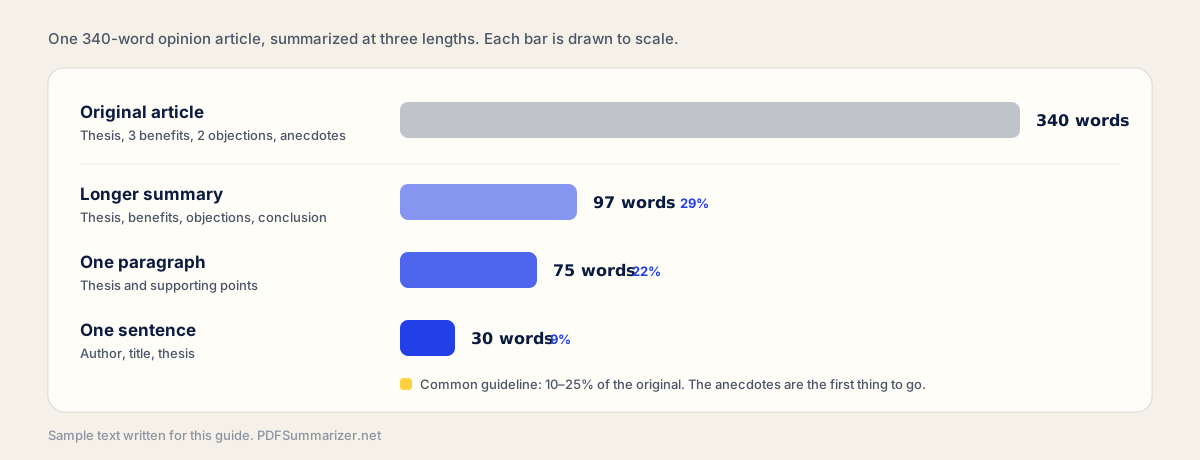
One sentence (30 words): In “Give Students Their Fridays Back,” Maya Jensen argues that a carefully designed four-day school week can improve teaching and learning, provided districts offer Friday childcare and adapt longer days.
One paragraph (about 75 words): In “Give Students Their Fridays Back,” Maya Jensen argues that a four-day school week is not a cost-cutting measure but a way to improve learning. She claims it gives teachers a regular day to plan together, reduces time lost at the start and end of the school day, and frees a weekday for family appointments. Jensen acknowledges concerns about childcare and tired younger students but suggests that Friday clubs and more breaks can address them.
Longer summary (about 95 words): In “Give Students Their Fridays Back,” Maya Jensen argues that a four-day school week, often seen as a way to cut costs, can improve teaching and learning if it is designed carefully. Teachers gain a regular day to plan lessons together, students lose less time to the slow start and end of each day, and families get a weekday for appointments. Jensen accepts that working parents need Friday childcare and that younger children tire in longer days, but proposes Friday clubs and tutoring, plus more breaks and hands-on work. She concludes that the model is worth trying.
Step 5 — the check. Comparing the paragraph with the original: every point is the author’s, there is no opinion about whether she is right, and no distinctive phrase is borrowed. The longer version adds her conclusion — that the change is worth trying — which the paragraph compresses into “a way to improve learning,” and the one-sentence version keeps only the thesis and the conditions attached to it.
For a much shorter example, take a text everyone knows. A one-sentence summary of Little Red Riding Hood: a girl sent to visit her grandmother is tricked by a wolf who eats them both, until a hunter rescues them. Notice what is gone — the basket, the path through the woods, the famous “what big eyes you have” exchange. They are memorable, but they are not the main point.
How long should a summary be?
There is no fixed rule, but a common guideline is 10–25% of the length of the original, and often less for long texts. A 2,000-word article might get a 200–400-word summary; a 300-page book gets a page or two, not thirty.
When an assignment sets the format, it usually asks for one of three lengths:
- One sentence — the author, the title and the thesis. Useful for introducing a source in an essay.
- One paragraph — the thesis plus the main supporting points. The most common format.
- One page — the thesis, each supporting point with its key evidence, and the conclusion.
Whatever the length, a summary should be much shorter than the original. If yours is more than a third of the source, you are retelling it rather than summarizing it.
Summary format and template
The standard format is simple, and it works for almost any text:
- First sentence: introduce the source — the author’s full name, the title, and the author’s thesis in one sentence.
- Body: the supporting points in the order that best explains the argument, usually the author’s order. One or two sentences each.
- Last sentence: the author’s conclusion or the broader implication they draw — not yours.
A template you can copy:
In [title], [author’s full name] argues that [main idea]. [He/She/They] supports this by [first key point], [second key point] and [third key point]. [Author’s last name] also acknowledges [counterargument, if any] but [how the author responds]. [Author] concludes that [author’s conclusion].
After the first sentence, refer to the author by last name only. Use the present tense (“Jensen argues”), which is the convention for discussing what a text says.
How to write a summary of an article
Summarizing an article is the most common assignment, and articles have a helpful structure: the headline, the first paragraph and the last paragraph together often contain the whole argument. Read those three first, then skim the section headings to see how the original article is organized.
News articles need one adjustment. They are written in an inverted pyramid, with the most important information at the top, so your summary should follow the same order: what happened, who was involved, why it matters. Leave out the quotes from sources unless a quote is the news.
Summarizing a book, a research paper and a meeting
Summarizing a book
For a book, summarize by chapter first, in two or three sentences each, and then summarize the summaries. Fiction needs the protagonist, the central conflict and how it resolves; nonfiction needs the thesis and the main argument of each part. If you want a head start on a long book, a book summarizer can outline the chapters for you to check against your own reading.
Summarizing a research paper
A research paper already has an abstract, but a summary for a class or a literature review needs to go beyond it. Cover the research question, the method and sample, the main findings and the limitations the authors note. Our guide on how to write a literature review shows how summaries of individual papers turn into a synthesis. For a first pass through a stack of papers, a research paper summarizer gives you the structure of each one.
Summarizing a meeting
For a meeting, the main idea is what was decided. Lead with decisions and next steps, with owners and deadlines, then add the key points of discussion. Nobody needs the order in which people spoke.
Reporting verbs and transitions for a summary
Reporting verbs let you introduce the author’s ideas without repeating “says.” Choose the verb that matches what the author is doing:
| The author is… | Verbs to use |
|---|---|
| Making a claim | argues, claims, asserts, contends, maintains |
| Explaining | explains, describes, outlines, illustrates |
| Suggesting cautiously | suggests, proposes, implies |
| Agreeing or conceding | acknowledges, concedes, admits |
| Concluding | concludes, recommends, calls for |
Transitional words keep the summary from reading like a list: first, in addition, however, as a result, finally. Use them to show how the author’s points relate — which one supports which, where the author changes direction — rather than just stacking sentences.
Check your summary against an AI summary
AI tools can summarize a text in seconds, which raises a fair question: why learn to do it yourself? Because the skill is not the summary. It is the reading and judgment that produce it — deciding what the author’s main point is and what can be left out. That is what an assignment tests, and what you need when you read anything that matters.
AI is still useful as a checking tool. Write your own summary first, then paste the original into a text summarizer and compare:
- Did the AI pick a different main idea? Reread the introduction and conclusion to see who is right.
- Did it include a key point you left out? Decide whether it is essential or a detail.
- Did it add anything the author did not say? That happens, and spotting it is good practice.
For long files, our guide on how to summarize a PDF covers how to check an AI summary against the source in a few minutes.
Most schools treat submitting AI-generated text as your own work as academic misconduct. Use AI to check your understanding, not to replace the writing.
Common mistakes when writing a summary
- Adding your opinion. “Jensen makes a convincing case” is analysis, not summary. Leave it out, or save it for a separate response paragraph.
- Including too many details. Examples, statistics and anecdotes illustrate a point; the summary needs the point. Keep only the relevant information.
- Quoting instead of restating. A summary should rarely contain quotes. If a phrase is so distinctive you must borrow it, put it in quotation marks and cite it.
- Following the original too closely. Changing a few words in each sentence is still plagiarism. Writing from notes, with the text closed, avoids it.
- Losing the conclusion. Many summaries cover the supporting points and forget where the author was going. The final sentence should state the author’s conclusion.
- Forgetting the source information. Always name the author and the title, and add a citation if your assignment uses a citation style.
A final tip for writing a good summary: read it aloud. If a sentence would confuse someone who has not read the original, rewrite it, then check the grammar and cut every word that is not doing work.
Frequently asked questions
What are the 5 main points in a summary?
A good summary contains the author and title, the author's main idea or thesis, the key supporting points, the author's conclusion, and nothing else — no opinion and no minor details. Those five elements are what a reader needs to understand the original without reading it.
What is an example of a summary?
A one-sentence summary of Little Red Riding Hood: a girl sent to visit her grandmother is tricked by a wolf who eats them both, until a hunter rescues them. It keeps the main events and drops the details. For an article, a summary begins with the author's name, the title and the thesis, then gives the key points in a sentence or two each.
Should a summary include quotes?
Rarely. A summary restates the author's ideas in your own words, so quotes should be the exception. If you must use a distinctive phrase from the source, put it in quotation marks and cite it. Most instructors prefer a summary with no quotes at all.
How do you start a summary?
Start with one sentence that names the author, the title of the text and the author's main idea, for example: In “Give Students Their Fridays Back,” Maya Jensen argues that a well-designed four-day school week improves learning. After that first sentence, refer to the author by last name.
The short version
To write a summary, read the whole text, identify the author’s main idea, note the few points that support it, write from your notes with the source closed, and check your draft against the original. Keep it objective, keep it short, and start with the author, the title and the thesis. With a little practice you will be able to summarize almost anything in a paragraph — and understand it better for having done so.