Most guides on how to write a literature review describe the finished product: it should synthesize, not summarize; it should identify gaps; it should be organized by theme. All true, and almost no help when you are sitting in front of forty PDFs with a deadline. What students actually struggle with is the part in between — how you get from a pile of sources to a paragraph that synthesizes them.
This guide walks through that middle, step by step, using one example topic from the first search to a finished paragraph. By the end you will have seen the same body paragraph written twice, once as a summary and once as a synthesis, and you will know exactly what makes the difference.
What is a literature review in a research paper?
A literature review is a structured survey of the scholarly articles, books and other sources on a specific topic, which explains what is known, how it is known, where researchers disagree and what is still missing. It can be a standalone paper, a chapter of a thesis or dissertation, or a section of a larger paper such as a journal article or research proposal.
In short, a lit review has to summarize and synthesize. Its purpose is to justify new research. By the end of a good literature review, the reader should understand why your research question matters and why it has not already been answered.
What a literature review is not
- Not an annotated bibliography. An annotated bibliography summarizes each source separately. A literature review connects them.
- Not a research paper. A research paper presents new data or a new argument. The literature review sets up that contribution, which is why most research papers include a literature review.
- Not a book report. You are not expected to describe every source in detail — only what each one contributes to your question.
Before you write a literature review: which type is it?
Before you start, check which kind you are expected to write. The review process differs a lot.
| Type | What it does | Typical use |
|---|---|---|
| Narrative review | Surveys and interprets the literature on a topic | Most student papers, thesis chapters |
| Systematic review | Answers a precise question using a predefined, reproducible search | Medicine, health, policy |
| Scoping review | Maps how much research exists and what kinds | New or broad research areas |
| Integrative review | Combines different methods, including qualitative research | Nursing, education |
| Meta-analysis | Statistically combines results from several studies | Where studies measure the same outcome |
Systematic reviews are a serious undertaking: one analysis of registered reviews found they took an average of 67 weeks from registration to publication. If your assignment just says “literature review”, it almost certainly means a narrative review, and that is what the rest of this guide covers.
Step 1: Define your scope and research question
A literature review without a question turns into a list. Write down the question your review will answer, then set boundaries: which years, which populations, which fields of study, which kinds of source.
Our example: Does retrieval practice improve exam performance in university students? Boundaries: studies from 2006 onwards, university or high school settings, published in English, peer-reviewed articles plus major meta-analyses.
A good test is whether you can explain your research topic in one sentence and name what is out of scope. If you cannot, narrow the question before you search.
Step 2: Run a literature search
A literature search has three layers. Do all three, because each finds papers the others miss.
- Database search. Use Google Scholar plus at least one subject database (PubMed, PsycINFO,
ERIC, Scopus, Web of Science, JSTOR) and your library catalogue. List keywords and synonyms for
each concept, then combine them with Boolean operators:
("retrieval practice" OR "testing effect" OR "practice testing") AND (exam OR "course performance"). - Snowballing. Take your best papers and read their reference lists (backward) and the papers that cite them (forward). Citation-mapping tools such as ResearchRabbit and Connected Papers automate this — see our guide to the best AI for research.
- Review articles and grey literature. Existing review articles are a shortcut to the key sources. Theses, government reports and conference papers can show newer work that has not reached journals.
Good search techniques matter more than the number of databases. Keep a search log — databases, search terms, date and number of results. It takes two minutes per search and it will write your methods paragraph for you.
Step 3: Screening and evaluating sources
Your search will return far more than you can read. Screening in stages keeps the review process manageable:
- Title screening. Discard anything clearly off topic.
- Abstract screening. Keep studies that match your question and boundaries.
- Full-text triage. For the survivors, get a fast overview of each paper’s research question, method, sample and key findings before committing to a close reading.
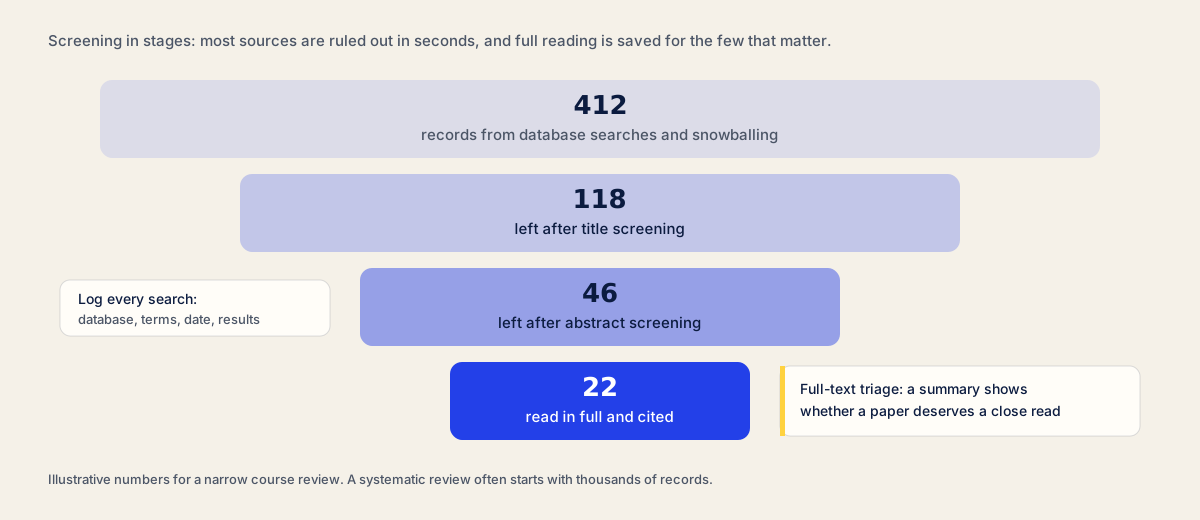
Stage three is where most time disappears. A free research paper summarizer can speed it up: upload the PDF and you get the research question, methods, main points and conclusions in a minute, and you can ask follow-up questions such as “what was the sample size?” or “what are the limitations?”. Use it to decide whether to read a paper closely, never instead of reading it.
A summary can omit a limitation, a subgroup or a caveat that changes how a study should be cited. If a source will appear in your review, read the full paper — at least the methods, results and limitations.
Evaluating sources
When evaluating sources, ask of each one:
- Relevance: does it address your question, or only your keywords?
- Credibility: is it peer-reviewed? Who funded it? Is the journal reputable?
- Method: is the design suited to the claim? How large is the sample?
- Currency: is it the latest evidence, or has newer research replaced it?
- Influence: is it a foundational study that everyone cites, which you must include?
Step 4: Take notes in a synthesis matrix
This is the step most guides skip, and the one that makes the writing easy. A synthesis matrix is a table with one row per source and one column per theme or feature. Filling it in forces you to read for comparison rather than for summary. If you need a refresher on summarizing a single source first, see how to write a summary.
| Source | Design and sample | Key findings | Condition that matters | Limitation |
|---|---|---|---|---|
| Roediger & Karpicke (2006) | Lab experiment, students | Testing beat rereading after one week (61% vs 40%) | Rereading won at five minutes | Prose passages, not course exams |
| Rowland (2014) | Meta-analysis | Testing effect, g = 0.50 | Larger with feedback | Mostly laboratory studies |
| Adesope et al. (2017) | Meta-analysis | Practice tests vs restudy, g = 0.61 | Holds across ages and formats | Few long-term classroom studies |
| Yang et al. (2021) | Classroom meta-analysis | Quizzing boosts course learning, g ≈ 0.50 | Real classes, real exams | Varied quiz formats |
This is also the easiest way to organize sources: a critical analysis is much easier when the key concepts sit side by side. Once the matrix is full, patterns jump out of the columns: agreement on the main effect, a condition that changes it, a limitation shared by many studies. Those patterns become your themes, and your themes become your headings.
If you use a chat-with-PDF tool, ask the same questions of every paper — design, sample, main finding, limitation — so your rows are comparable. Then verify each cell against the paper itself.
Step 5: Identify themes, debates and gaps
Read your matrix column by column and write one sentence for each pattern you see:
- Consensus: what do most studies agree on?
- Debates: where do they disagree, and is the disagreement explained by method, sample or context?
- Development: how has thinking changed over time?
- Gaps: what has not been studied, or only studied under narrow conditions?
In our example: there is consensus that practice testing beats restudying; the advantage depends on the delay before the test; and there is a gap in long-term evidence from real, high-stakes university courses. That last sentence is the justification for new research.
Step 6: Choose a structure and outline
There are three common organizational structures for the body of a literature review:
- Thematic: one section per theme. The most useful for almost every student review.
- Chronological: how the field developed over time. Good when the history matters.
- Methodological: grouped by research method, such as experiments versus classroom studies. Good when methods explain the disagreements.
A thematic outline for our example:
- Introduction: the question, why it matters, scope and search approach
- The testing effect in laboratory studies
- Evidence from real classrooms
- Conditions that change the effect: delay, feedback, format
- Gaps and directions for new research
- Conclusion
Give each section a clear heading, with subheadings for larger themes, and plan which sources go in which section before you write a word. Most sources will appear in more than one.
Step 7: Writing the literature review — introduction, body and conclusion
The introduction gives background information, defines the topic, explains why it matters, states the scope, and briefly describes how you found and selected sources. End it with a thesis statement: the overall argument your review makes about the literature.
The body follows your outline. Start each paragraph with a topic sentence that makes a claim about the literature, then use several sources to support, qualify or complicate it.
The conclusion summarizes the main findings of the review, states the gaps clearly and connects them to your own research question or to directions for future research.
Summarize vs synthesize: the same paragraph, twice
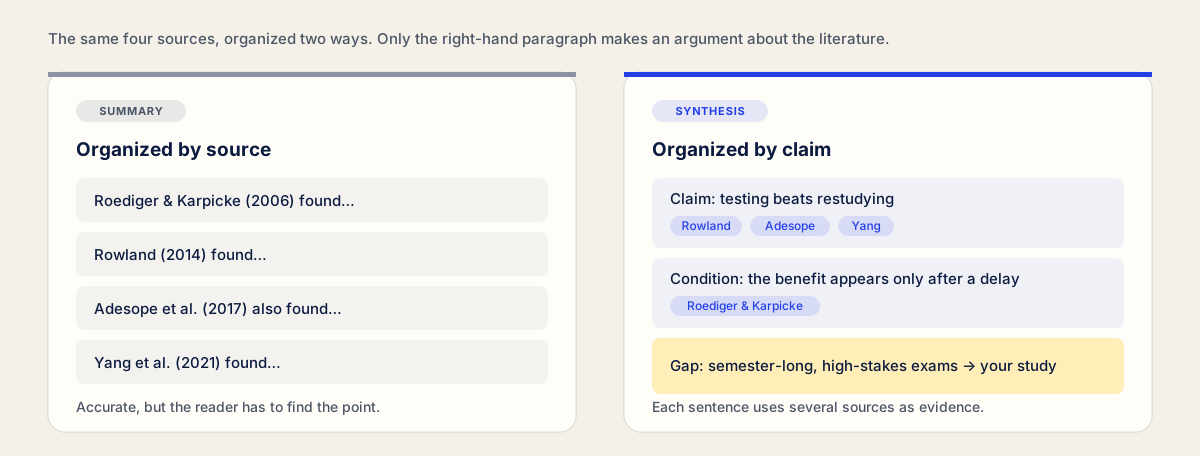
Here is a body paragraph written the way most first drafts are written — one source at a time:
Roediger and Karpicke (2006) found that students who were tested on a passage remembered more after a week than students who reread it. Rowland (2014) conducted a meta-analysis and found a testing effect of g = 0.50. Adesope et al. (2017) also conducted a meta-analysis and found an effect of g = 0.61. Yang et al. (2021) looked at classrooms and found that quizzing helped learning.
Every sentence is accurate, and the paragraph says almost nothing. Here is the same material, synthesized:
Across laboratory and classroom research, practice testing reliably outperforms restudying, with meta-analytic effects clustering around half a standard deviation (Rowland, 2014; Adesope et al., 2017; Yang et al., 2021). The advantage is not immediate, however: in Roediger and Karpicke’s (2006) experiment, rereading produced better recall after five minutes, and testing pulled ahead only after a week. Because most studies measure retention over days rather than a full semester, it remains unclear how large the benefit is on high-stakes final exams.
The second version makes a claim in its first sentence, uses several sources as evidence for it, qualifies it with a condition, and ends on a gap. That is what synthesize means in practice.
The five C’s of writing a literature review
The five C’s are a checklist many writing centers use. Every body section should do most of them:
- Cite — ground each claim in the relevant research, with a consistent citation style.
- Compare — show where studies agree, and why.
- Contrast — show where they disagree, and what explains it. Compare and contrast the results, not the authors.
- Critique — evaluate the strength of the evidence, not just its conclusions.
- Connect — link the literature to your own research question.
If a paragraph only cites, it is a summary. If it compares, contrasts and critiques, it is analysis. If it connects, it is doing the job of a literature review.
Literature review example: what a good one looks like
A good literature review example has a few features you can spot quickly: headings that name themes rather than authors, paragraphs that each discuss several sources, explicit evaluation words (“however”, “in contrast”, “a limitation shared by”), and a final section that names specific gaps.
To find real examples in your field, search Google Scholar for your topic plus “review”, or look at the introduction section of relevant articles in recent peer-reviewed journals — each one contains a short literature review of its own. Annual Review journals publish high-quality reviews across many subject areas.
Common mistakes in the review process
- Summarizing source by source instead of organizing sources around themes.
- No argument. The review never states what the literature, taken together, shows.
- Too broad a scope, so every theme gets a sentence and none gets analysis.
- Only agreeing sources. Leaving out contradictory research weakens your credibility.
- Over-quoting. Paraphrase and synthesize; quote only when the exact wording matters.
- Outdated sources in a field where newer research has changed the picture.
- Citing papers you have not read, including ones suggested by an AI tool.
Can I use ChatGPT for a literature review?
For some parts of the work, yes. ChatGPT and similar tools are useful for brainstorming search terms, explaining an unfamiliar method, suggesting an outline, and giving feedback on the clarity of a draft you wrote.
Do not use a general chatbot to find sources or write the review. In one 2023 study, more than half of the citations produced by GPT-3.5 in literature reviews were fabricated, and 18% of GPT-4’s were. AI tools that search real databases — Elicit, Consensus, Semantic Scholar — are far safer for finding papers, and a summarizer grounded in the PDF is safer than a chatbot’s memory for reviewing what a paper says. Whatever you use, check your institution’s policy on AI and disclose it where required.
Frequently asked questions
Is it hard to write a literature review?
It is time-consuming more than it is hard. The difficult part is moving from summarizing sources to synthesizing them. Working through a synthesis matrix before you write, and organizing the review by themes rather than by authors, makes the writing much easier.
How long should a literature review be?
It depends on the assignment. A literature review inside a journal article may be a few paragraphs, a standalone course paper often runs 1,500 to 5,000 words, and a thesis or dissertation chapter can be 20 to 40 pages. When in doubt, ask your instructor or look at examples in your field.
Do you write a literature review in past tense?
Use the past tense or present perfect when describing what specific studies did or found, such as 'Rowland (2014) found' or 'researchers have shown'. Use the present tense for your own analysis and for established knowledge. APA style recommends past tense or present perfect for the literature review.
Can I write a literature review in 5 days?
For a short course paper with a narrow scope, yes: one day to search, two days to screen, read and fill a synthesis matrix, one day to outline and draft, and one day to revise. A thesis chapter or systematic review needs weeks or months.
How many sources should a literature review have?
There is no fixed number. Short undergraduate reviews often use 10 to 20 sources, master's theses 40 to 80, and doctoral theses more. Aim to cover the key studies and main debates on your topic rather than hitting a count.
The short version
To write a literature review: define a narrow question, search in three layers, screen hard, record every source in a synthesis matrix, turn the matrix’s patterns into themes, and write paragraphs that make claims about the literature instead of describing sources one by one. If each paragraph cites, compares, contrasts, critiques and connects, your literature review is doing its job.